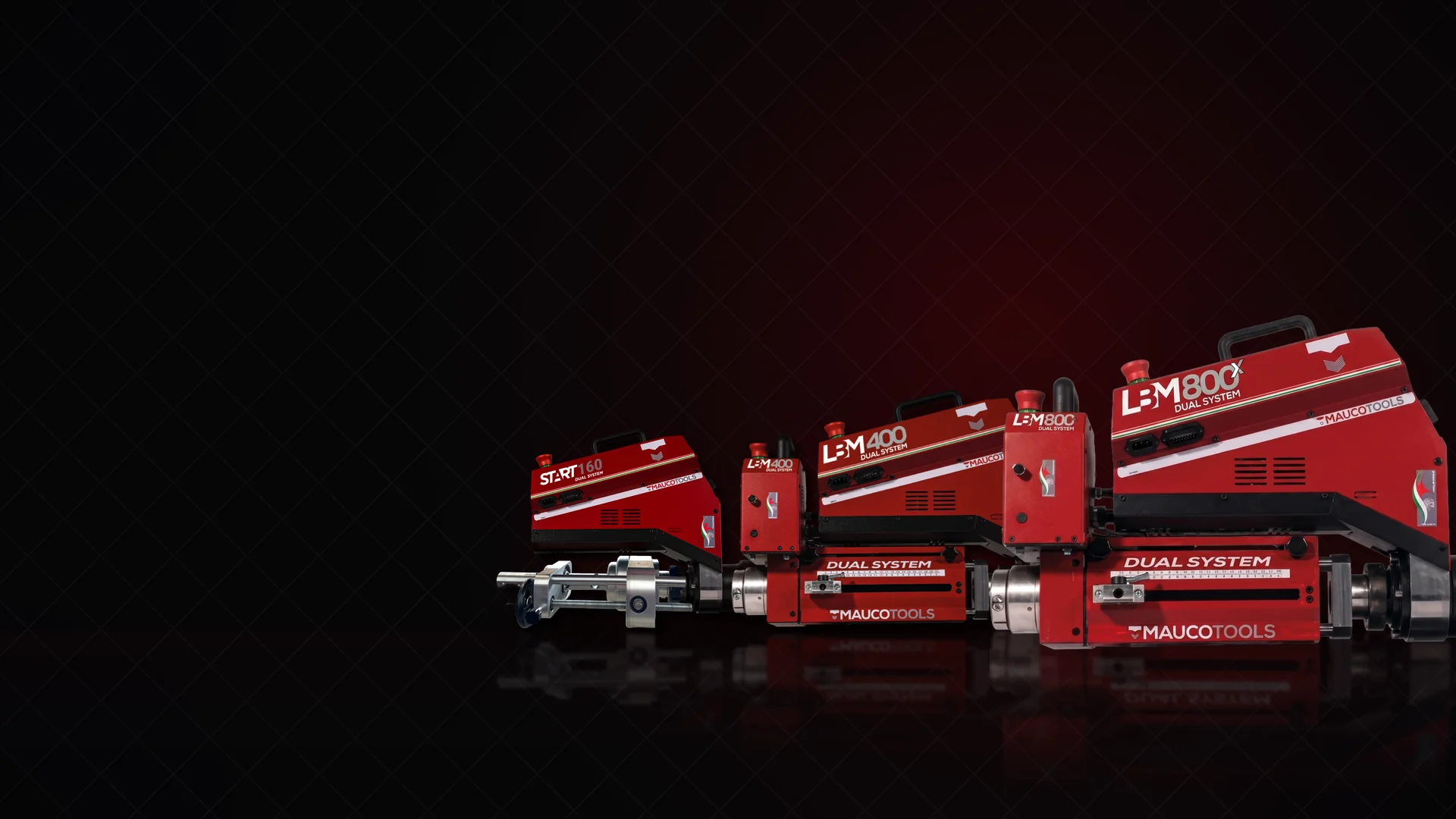
Choosing a portable line boring machine comes down to six criteria: the range of diameters to be machined, whether or not welding overlay is required, the sector of use, electric or hydraulic drive, weight and transportability, and frequency of use. Within the Maucotools range these criteria lead from the compact START160, designed for a single operator, all the way to the LBM600X for the most demanding jobs.
The most common risk is not buying the wrong machine in absolute terms, but buying the wrong one for the actual work: an undersized boring machine forces you to turn jobs away, while an oversized one weighs more, is slower to set up and ties up capital that earns nothing. This is as true for the mobile workshop that bills per job as it is for the maintenance department that has to cover a defined fleet.
This guide runs through the criteria in the order it makes sense to apply them, then summarizes the range model by model with the catalogue figures, so you arrive at your choice — or a shortlist of two candidates — backed by concrete data.
For the fundamentals of the process, the complete guide to line boring is the starting point.
If you also need to reface flange sealing faces, read how to choose a flange facing machine.
Portable Line Boring Machine: The Criteria That Really Matter
A portable line boring machine is a modular machine tool that mounts directly onto the component to be machined — an excavator pivot joint, a bearing seat, a turbine casing — and restores its bores in situ, without removing the part or shipping it to a workshop. The traditional alternative, removal and transport, costs weeks of downtime: it is against that cost that the purchase must be measured.
The selection criteria, in order of practical priority:
- Diameter range: the toughest filter. If the bore does not fall within the working range, nothing else matters.
- Welding overlay: do you need to rebuild worn material before reaming, or is line boring alone enough?
- Sector of use: earthmoving, hydropower, Oil & Gas and the mobile workshop each impose different constraints on diameters, access and environments.
- Drive: electric or hydraulic, depending on what is available on site.
- Weight and transportability: who mounts the machine, where, and at what height.
- Frequency of use: one job a month or three a week justify different machine classes.
In the paragraphs that follow, each criterion is cross-referenced with the models in the range.
Diameter Range: The First Filter
Every line boring machine works a diameter range defined by the bar and the support structure. It pays to think not about the single job that triggered the purchase, but about the histogram of bores that pass through the workshop over a year.
The working ranges in the Maucotools catalogue:
- START160: Ø22–160 mm (0.9–6.3 in), with 20 and 40 mm bars.
- LBM250: working range Ø22–250 mm (0.9–9.8 in) (line boring from Ø42 to 250 mm), 20 and 40 mm bars.
- LBM400: line boring Ø42–400 mm (1.7–15.7 in) with 40 mm bar.
- LBM600: line boring Ø42–600 mm (1.7–23.6 in), with 40, 50, 60 and 80 mm bars.
- LBM600X: line boring Ø62–600 mm (2.4–23.6 in) with 60 mm bar.
- OB200 / OB400: orbital line boring machines, Ø22–200 mm and Ø42–400 mm respectively.
Two practical notes. First: the bulk of bores on mid-size earthmoving machines — bucket bushings, boom pivot joints — falls below 250 mm, which is the natural territory of the LBM250. Second: if even a minority of the work exceeds that threshold (large excavator joints, slew rings, quarry-machine hinges), stepping up to the LBM400 covers up to Ø400 mm while keeping the same modular logic. Above 400 mm — turbines, large infrastructure, mining components — you enter the domain of the LBM600.
Line Boring Only or Welding Overlay Too
This is the fork that separates two families of machines. If the seats to be restored are simply out of geometric tolerance, line boring alone is enough: the bore is brought back to correct size and geometry. But in real-world maintenance the most frequent case is wear that has removed material: before reaming you have to rebuild, and rebuilding means welding overlay.
With a line-boring-only machine the overlay has to be done by hand or with separate equipment, and every tooling change means dismounting, remounting and, above all, re-centering. Maucotools' patented Dual System technology eliminates the double positioning: the same machine performs the welding overlay on the worn seat and then reams it to nominal size, with a single centering operation. The setup documented in the case studies is on the order of 14 minutes, with final tolerances down to H7.
How to choose:
- Line boring only: START160 (seat restoration, no integrated overlay) and the OB200/OB400 orbital machines. Suitable when overlay is not needed or is handled separately.
- Line boring + overlay (Dual System): LBM250 (internal overlay 32–250 mm, external 22–250 mm), LBM400 (internal 32–250 mm, external 22–250 mm), LBM600 (internal overlay up to Ø600 mm), LBM600X (internal 32–600 mm, external 22–600 mm).
For a mobile workshop that lives on wear-repair jobs, integrated overlay is not an option: it is the difference between finishing the job in a day and coming back twice.
Sector, Drive and Frequency of Use
The sector of use dictates typical diameters, access conditions and the power source available.
- Earthmoving: bushings, pins and joints mostly below Ø250 mm on mid-size machines, larger on big excavators. LBM250 for the mid-size class, LBM400 for the large class and heavy joints. A concrete reference: the bucket of a Caterpillar 307.5 rebuilt and reamed to H7 tolerance with the LBM250.
- Hydropower: large-diameter bearing seats and couplings, often inside the plant, where the cost of downtime dominates everything. This is the domain of the LBM600: in the case of the 12 MW Francis turbine with a Ø510 mm bearing seat, the plant was back on the grid in 2 days versus roughly 3 weeks with the traditional method (the full case).
- Oil & Gas: heavy components, remote sites, stringent requirements. LBM400 and LBM600 cover most interventions; for the most demanding large-diameter jobs the reference is the LBM600X.
- Mobile workshop: versatility is what counts. The LBM400 is the most versatile machine in the range — Ø42–400 mm line boring plus overlay — while the LBM250 remains the choice when the customer base is made up of mid-size earthmoving machines.
On drive, the LBM250 and LBM400 are available with a 1.8 kW electric or a 5.5 kW hydraulic motor. The electric version works anywhere there is mains power or a generator; the hydraulic version taps the power pack or auxiliary outlets already present on site and, in heavy applications, delivers more power. The LBM600X carries a 2.3 kW High Torque electric motor with a 4-speed mechanical gearbox, designed to hold torque on heavy large-diameter machining.
On weight and transportability, the modular architecture makes the practical difference: on the LBM250 the single module weighs about 17 kg (37 lb) and can be mounted by one operator, even in awkward positions. The START160 is the lightest in the range, explicitly sized for the single operator.
Finally, frequency of use decides the investment class. For occasional use on contained diameters, an entry-level machine like the START160 restores seats without tying up capital. For continuous professional use, the ruggedness and coverage of an LBM pay off on every job: to estimate in how many jobs the machine pays for itself compared with the remove-and-workshop alternative, the ROI calculator is available on the Maucotools website.
Mini-Profiles: The Range Model by Model
START160 — Entry-Level for the Single Operator
- Line boring Ø22–160 mm (0.9–6.3 in), 20 and 40 mm bars.
- Automatic and manual mechanical feed.
- Ultra-light, mountable and operable by a single operator.
- Line boring and seat restoration only: no integrated overlay.
- For whom: occasional use or first step into in-situ machining, small and medium bores.
LBM250 — The Benchmark for Mid-Size Earthmoving
- Working range Ø22–250 mm; line boring Ø42–250 mm, 20 and 40 mm bars.
- Internal welding overlay 32–250 mm and external 22–250 mm (Dual System).
- Drilling and tapping from 10 to 45 mm.
- 1.8 kW electric or 5.5 kW hydraulic; modules of about 17 kg (37 lb), single-operator mounting.
- For whom: mobile workshops and maintenance teams on mid-size excavators and earthmoving machines.
LBM400 — The Most Versatile in the Range
- Line boring Ø42–400 mm (1.7–15.7 in) with 40 mm bar.
- Internal overlay 32–250 mm, external 22–250 mm.
- 1.8 kW electric or 5.5 kW hydraulic.
- For whom: large-size earthmoving, heavy joints, Oil & Gas interventions; the mobile workshop that wants a single machine for almost everything.
LBM600 — Large Diameters and Large Plants
- Line boring and internal overlay Ø42–600 mm.
- 40, 50, 60 and 80 mm bars; drilling and tapping from 10 to 65 mm.
- For whom: large infrastructure, mining, hydropower, Oil & Gas. It is the model behind the 12 MW Francis turbine case.
LBM600X — The Flagship for Heavy-Duty Jobs
- Line boring Ø62–600 mm (2.4–23.6 in) with 60 mm bar.
- Internal overlay 32–600 mm and external 22–600 mm.
- 2.3 kW High Torque motor, 4-speed mechanical gearbox.
- For whom: intensive use on large diameters, continuous heavy-duty machining.
OB200 and OB400 — The Orbital Machines
- Orbital line boring Ø22–200 mm and Ø42–400 mm respectively.
- For whom: applications where the orbital technique is the correct technical choice and overlay is not required.
FAQ
Which portable line boring machine is right for a mobile workshop?
It depends on the customer base. If the work is concentrated on mid-size earthmoving machines, the LBM250 covers bores up to Ø250 mm with integrated overlay and modules of about 17 kg (37 lb) that one operator can mount. If large joints or Oil & Gas jobs also come up, the LBM400 extends line boring up to Ø400 mm and is the most versatile machine in the range.
Electric or hydraulic drive — which is better?
The 1.8 kW electric is the standard choice where there is mains power or a generator: simple to power and suited to most interventions. The 5.5 kW hydraulic is preferable on sites where a hydraulic power pack is already available and in heavy machining that demands more power. The LBM250 and LBM400 are available in both versions.
Do you really need integrated welding overlay?
If the seats to be restored show wear with material loss — the most frequent case on bushings and pins — then yes: without integrated overlay you have to weld with separate equipment and then re-center the boring machine, with added time and risk of error. With the Dual System the same machine overlays and reams with a single centering operation, with tolerances down to H7.
Does a larger machine also cover the small jobs?
Only in part. The lower limit of the working range is real: the LBM600X, for example, starts at Ø62 mm in line boring, whereas the LBM250 goes down to cover a working range from Ø22 mm. An oversized machine is also heavier to handle and slower to set up on small jobs: the correct criterion is the effective range of the bores you actually machine, not the theoretical maximum.
How long does on-site setup take?
The modular architecture is designed for quick mounting on the part: in the case study documented by Maucotools the setup was about 14 minutes. That figure should be read as the result of a real intervention, not as a guarantee: the actual time depends on access, component geometry and site conditions.
In short: first the diameter range, then the welding overlay question, then sector, drive, weight and frequency of use. Applied in this order, the six criteria almost always narrow the choice to one or two models in the range.
To go straight to the right candidate starting from the diameters and the type of intervention, the Maucotools configurator suggests the model based on your needs; for non-standard cases there is always the discussion with technical support. Before requesting a quotation, our guide to the portable line boring machine price explains what drives the cost and what really affects the total. Whatever machine you choose, welding overlay and work at height must always be carried out in compliance with safety rules and the manufacturer's instructions.