A pipe cold cutting and beveling machine parts a pipe and machines a weld-ready bevel in one simultaneous operation. Orbital split-frame units like the Maucotools SFM clamp around an in-line pipe and cut it cold — no flame, no heat-affected zone — producing uniform, radiographic-compliant ends that need no post-cut rework.
On a live piping run, the expensive part of a tie-in is rarely the cut itself. It is the sequence around it: stopping the line, removing a spool, hauling it to a shop, then squaring and beveling the end before a welder can strike an arc. Every extra setup adds hours and one more chance to get the bevel angle wrong.
Machining the cut and the bevel together, in place, collapses that sequence into a single setup. The pipe never moves, the end is weld-ready as soon as the frame comes off, and the bevel geometry repeats from joint to joint — which is exactly what a radiographic inspection is going to check.
What is a pipe cold cutting and beveling machine?
A pipe cold cutting and beveling machine is a portable tool that clamps around a pipe, drives a tool block orbitally around the circumference, and severs the pipe while simultaneously machining a weld-preparation bevel on the retained end. Cold cutting means it removes metal with a tool bit, not heat: no oxy-fuel flame, no abrasive disc, no plasma.
The split-frame design is what makes in-line work possible. The frame opens, wraps around a pipe that is still in the rack or trench, and closes — so you never break the run to slip a machine over a free pipe end. Maucotools builds this as the SFM orbital split-frame cold-cutting range, sized from 2 to 60 in. outside diameter.
What is a weld-prep bevel?
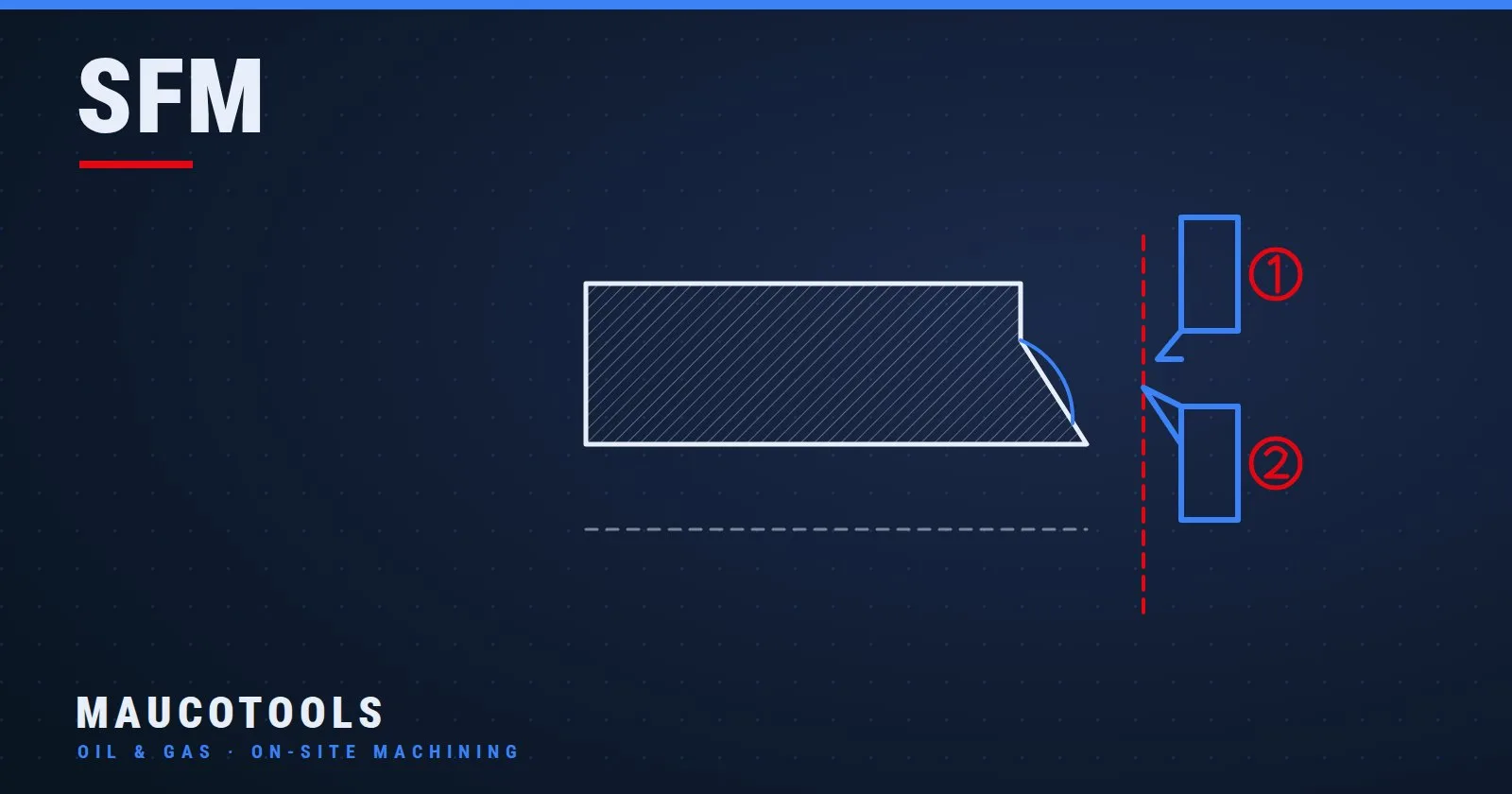
A weld-prep bevel is the angled land machined onto a pipe end so two pipes form a groove a welder can fill with full penetration. Get the angle, land, and squareness right and the root fuses cleanly; get them wrong and you invite lack of fusion — the defect radiographic testing is most likely to reject.
One pass vs two setups: why simultaneous cut and bevel wins
The traditional route treats cutting and beveling as separate jobs: part the pipe with a saw, wheel, or torch, then mount a second tool to face and bevel the fresh end. Each handoff costs time and introduces error. Doing both on one orbital pass removes the handoff entirely.
Against cut-then-bevel-separately, a single-setup cut and bevel gives you:
- One clamp-up, not two. The machine is dialed in once; there is no re-centering a second tool and no re-clocking the bevel to the cut.
- No post-cut rework. The end leaves the frame weld-ready — no deburring a torch-cut edge, no grinding a saw kerf square.
- Repeatable geometry. Every joint gets the same bevel angle and land, so fit-up and inspection stay consistent down the run.
- Less downtime. One setup on the live line beats removing a spool, moving it, and bringing it back — often the difference between hours and days.
Why radiographic-compliant, distortion-free ends matter
A weld that has to pass radiographic testing needs a bevel that is uniform all the way around and true to its nominal angle. Distortion in the bevel geometry shows up later as inconsistent root gaps, uneven penetration, and rejectable indications on the film.
This is where cold cutting earns its place. Because a tool bit removes material instead of heat, there is no heat-affected zone and no thermal distortion of the bevel angle — the metallurgy of the pipe end is left intact. The Maucotools SFM is built to deliver uniform cuts and bevels with radiographic welding standard compliant results, and with no gas or abrasive disc consumption.
Flame and abrasive methods lose on both counts: they harden and distort the edge, and they leave a surface that has to be dressed back to clean parent metal before welding. On stainless and alloy lines, that thermal insult is a metallurgical problem, not just a cosmetic one.
SFM models, pipe sizes, and drive options
The SFM range covers pipe from 2 to 60 in. outside diameter across six frame sizes, each matched to an OD band:
- SFM-26 — 2 to 6 in. OD
- SFM-612 — 6 to 12 in. OD
- SFM-1218 — 12 to 18 in. OD
- SFM-1824 — 18 to 24 in. OD
- SFM-2432 — 24 to 32 in. OD
- SFM-4860 — 48 to 60 in. OD
Every frame is offered in three drive versions — pneumatic, electric, and hydraulic — so you can match the power source to the site. Air suits classified areas, electric suits shops and rack rooms, and hydraulic suits heavy-wall pipe and remote work off a power pack.
The smallest frame shows the class. The single-operator SFM-26 clamps pipe from 50.8 to 152.4 mm (2–6 in.), turns at roughly 34–37 rpm, and weighs 17.5 kg (38.5 lb) net, with a 4 HP pneumatic, 1.5 kW electric, or 5 HP hydraulic drive. Need a frame sized to your exact schedule? Build your spec in the configurator.
SFM vs PBM: cutting and beveling or facing only?
Not every weld prep starts with a cut. The deciding question is simple: do you need to part the pipe, or only re-work an end that is already open?
Choose cut and bevel — the SFM — when you have to sever an in-line pipe and hand the welder a beveled end in the same operation: tie-ins, spool replacement, or cutting out a corroded section. Choose beveling or facing only when the pipe end already exists and just needs a fresh, square, correctly angled face.
For those facing-only jobs, Maucotools offers the PBM portable bevelling and facing machines and a dedicated facing kit. Same cold-cutting principle, but the tool prepares an existing end rather than parting the pipe.
Common mistakes in pipe cutting and beveling
- Torch-cutting weld prep. A flame cut leaves a heat-affected, out-of-square edge that has to be ground back before it can be welded to standard — the rework the machine is meant to eliminate.
- Cutting and beveling in two setups. Separate operations mean re-centering, and a real risk the bevel ends up no longer concentric with the cut.
- Ignoring the OD band. Each SFM frame is built for a specific outside-diameter range; forcing a size compromises the clamp and the finish.
- Wrong drive for the area. Running electric in a classified zone, or under-powering heavy-wall pipe, stalls the job — match pneumatic, electric, or hydraulic to the site.
- Skipping fit-up checks. Even a clean bevel fails inspection if the joint is misaligned; verify the land and root gap before welding.
Frequently asked questions
Can you cut and bevel a pipe at the same time?
Yes. An orbital split-frame machine such as the SFM parts the pipe and machines the weld-prep bevel in one simultaneous operation, so the retained end is weld-ready as soon as the cut is complete.
What is the difference between cold cutting and flame cutting?
Cold cutting removes metal with a tool bit, so there is no flame, no heat-affected zone, and no thermal distortion of the bevel angle. Flame and abrasive methods apply heat, which hardens and distorts the edge and usually forces post-cut rework before welding.
What pipe sizes can the SFM handle?
The SFM range covers 2 to 60 in. outside diameter across six frame sizes, from the SFM-26 (2–6 in.) to the SFM-4860 (48–60 in.). Each frame is available in pneumatic, electric, or hydraulic drive.
Do I need an SFM or a PBM?
Use the SFM when you have to cut through an in-line pipe and bevel it in the same pass. Use a PBM machine, or the facing kit, when the pipe end already exists and only needs to be faced or re-beveled.
Why does a distortion-free bevel matter for radiographic welds?
Radiographic testing rejects welds with inconsistent penetration and lack of fusion, both of which trace back to an uneven or off-angle bevel. A cold-cut, uniform bevel keeps root gap and fit-up consistent, which is what lets the finished weld pass the film.
Cutting and beveling in one pass is not just faster — it removes the extra setups and the thermal damage that put welds at risk of failing inspection. For in-line parting where the welder needs a ready bevel, an orbital split-frame cold-cutting machine turns a multi-stage shop job into a single operation on the live run.
Weigh the sizes and drives against your own pipe schedule and downtime cost with the ROI calculator, and confirm the specifics before you cut. As with any work on process piping, isolate and depressurize the line and follow the machine's operating instructions and your site safety procedures.