The price of a portable line boring machine depends on five factors: the range of bore diameters it can machine, whether or not it has integrated bore welding, the type of drive, the accessory kits and the training and after-sales services. There is no single price list that fits every buyer: for portable line boring machines the quote is built around the job to be done.
Anyone searching for «portable line boring machine price» finds generic tables and figures with no context. A machine that bores from Ø22 mm and one that reaches Ø800 mm have different frames, bars and drives, and a configuration with integrated welding, facing kit and on-site training has nothing in common with a base machine.
Portable line boring machine price: the five factors that set it
The price of a portable line boring machine is the sum of five items, each tied to a technical choice:
- Bore range: the wider it is, the larger the frame, the bars and the drive become.
- Integrated Dual System bore welding: weld build-up in the same setup, or boring only.
- Drive: electric or hydraulic motor, with different power ratings and speed control.
- Accessory kits: facing, large diameters, threading, drilling, measuring instruments.
- Training and support: commissioning, operator training, spare parts and technical support over time.
Generic tables ignore these variables and compare machines that cannot be compared. The right way to get a number is to start from the job: the configurator builds the machine with the kits it needs, and the quote is calculated on that configuration. The size, however, is not chosen on price but on the bores and the industry: the criteria are in the guide on how to choose a portable line boring machine by diameter and sector; here it is taken for granted that the model has already been identified.
What moves the price: bore range, Dual System, drive, kits
Bore range
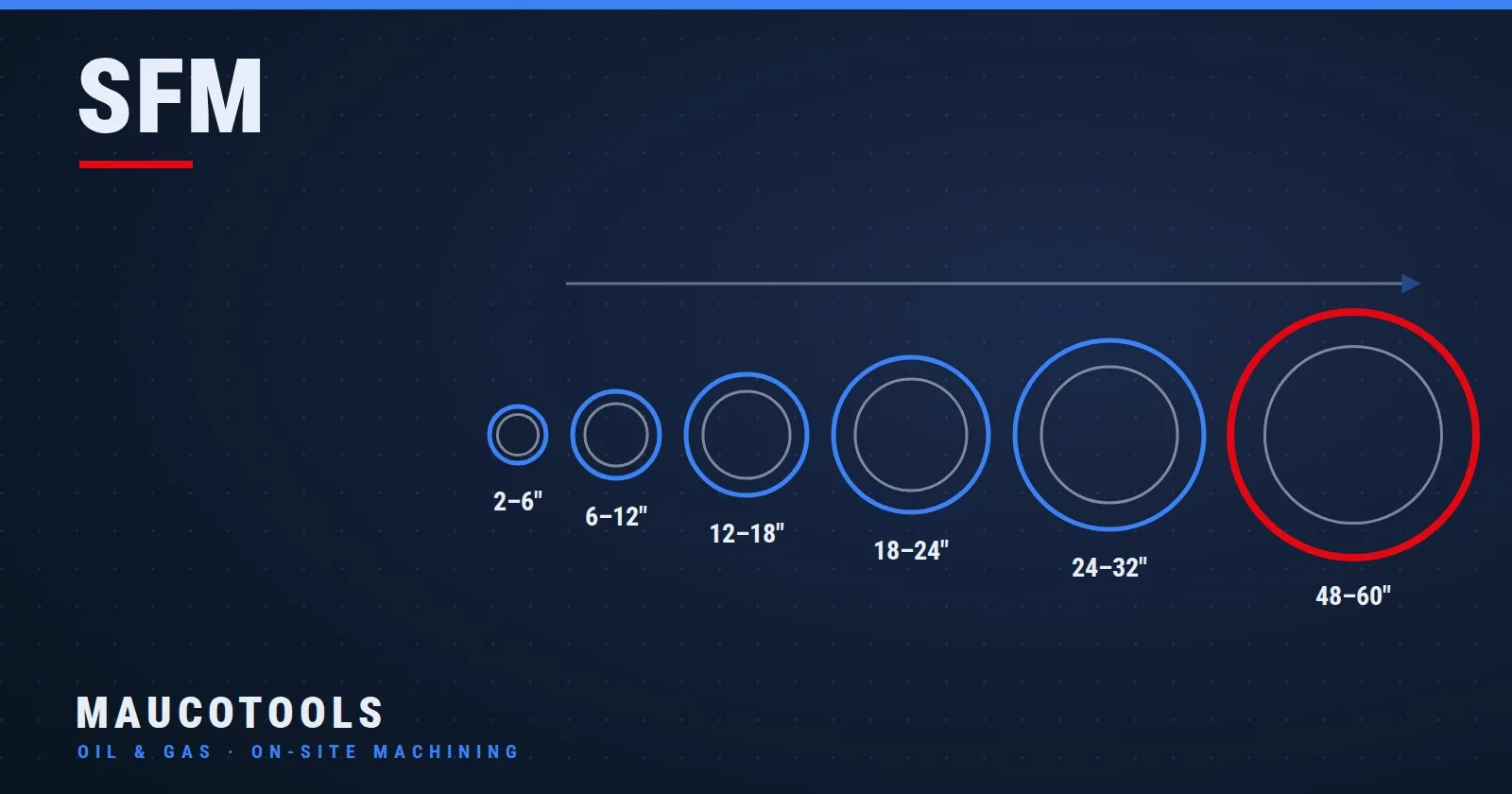
This is the first price factor. The Maucotools range starts with the LBM250, which bores from Ø22 to 250 mm, continues with the LBM400 (Ø42–400 mm) and the LBM600 (Ø42–600 mm) and reaches the LBM800X, from Ø62 to 800 mm. Moving up the range increases bar diameter and length, bearing support rigidity, the torque required from the motor and, as a result, weight and cost.
Integrated Dual System welding or boring only
On the LBM line boring machines and the START160X, welding is integrated: the same machine, with separate rotation and feed modules, builds up the worn bore by welding and then bores it back to size, without changing setup. On the OB200 and OB400 orbital machines and on the START160, welding is optional, with a kit to be added. The integrated version has a higher list price, but it has to be compared with the real alternative: a second piece of equipment for welding, a second setup with its own centring and the time lost between the two operations.
Electric or hydraulic drive
All models are available in an electric version, powered at 220–230 V, or a hydraulic version. The standard electric motor is rated 1.8 kW; on the LBM600X and LBM800X it is a 2.3 kW four-speed unit, with speeds from 30 to 630 rpm to match rotation to the bore diameter and the material. The hydraulic version, rated 5.5 kW, is chosen on sites that already have a power unit or where the electricity supply is not reliable.
Accessory kits
The kits extend the range of operations and affect the quote in proportion to how many are added:
- FK facing kits (FK250, FK400, FK600, FKX) for bore faces, with FKSS for circlip grooves and KTE for external turning up to Ø400 mm.
- KGD large diameter kit, patented, from Ø400 to 2,000 mm, compatible with most line boring machines on the market.
- TK threading kit, usable only with the dedicated tool holders.
- Drilling kit and measuring instruments, for centring and checking the job.
Training and support
This is the most underestimated item. A portable line boring machine only delivers results if the operator knows how to set it up, centre it and set the parameters: a quote that includes commissioning and training costs more, but it cuts errors and learning time. Spare parts and support over the years matter too: with its own production, Made in Italy, Maucotools supplies them directly.
The total cost: tooling, consumables, training, maintenance, downtime
The purchase price is the most visible item, but not the only one. The full line boring machine cost also includes the running costs:
- Tooling and inserts. Tool holders, inserts and bars wear out and have to be replaced depending on the materials and the number of jobs.
- Welding consumables. Wire and shielding gas for the build-up, in proportion to the material to be rebuilt.
- Operator training. If it is not included in the offer it has to be added; in any case the learning time has to be considered.
- Routine maintenance. Support bearings, bars, cables and connectors have to be checked and replaced to maintain accuracy, which on site reaches H7 tolerance.
- Downtime of the customer's machine. This is the cost that weighs more than any other, and it is the one the purchase is meant to reduce.
When an excavator, a press or a turbine stops, every hour of downtime has a cost that adds up quickly. In the documented case of a 12 MW Francis turbine, on-site machining with an LBM600 brought the plant back on line in 2 days, against roughly 3 weeks for dismantling and shipping to a workshop. The total cost of a portable line boring machine has to be read together with the downtime it avoids. For a closer look at the operation itself, from centring to finishing, the complete guide to line boring describes the cycle step by step.
Buying a line boring machine or outsourcing the job to a machine shop
Buying is not always the right choice: a specialised outside machine shop remains a valid option when jobs are rare and not urgent. The criteria to weigh together are qualitative:
- Number of jobs per year. Occasional jobs favour outsourcing; recurring jobs favour buying.
- Distance to the sites. Transporting an excavator boom to a workshop costs time and vehicles.
- Urgency. If downtime costs money every hour, waiting for the outside shop to become available is already a cost.
- Skills and available operators. At least one trained and available person is needed.
- Recurring repairs on the same components. Bucket pins, boom joints, bearing housings: when the same operation comes back, the equipment pays for itself.
The two published case studies show the two extremes. At the hydroelectric plant the line boring machine answered a shutdown that cost money every day, on a component impossible to move. On the bucket of a Caterpillar 307.5, Officina Mobile Torsani bored and rebuilt the pin bores with an LBM250, restoring H7 tolerances at the customer's premises: here the machine is the daily tool of a company that sells the service. Between the two extremes lies the break-even point, different for every company: no threshold applies to everyone. The ROI calculator compares on-site machining with an outside workshop using the user's real data and returns the payback time of the investment.
New or used portable line boring machine: what to check
A used portable line boring machine can be a good buy, provided you know what to check. Those who compare the «portable boring machine price» of new and used units often look only at the difference in figures, whereas the deciding variable is the mechanical condition of the machine. Points to verify:
- Play in bars and bearing supports. Play in the supports transfers to the bore as ovality and taper.
- Condition of bearings and bars. Scored or bent bars have to be replaced; the cost has to be added to the asking price.
- Motor and feed. Smooth rotation at all speeds, working feed and limit switches, undamaged cables.
- Documentation and manual. Without the operating manual and assembly instructions, training the operator becomes a problem.
- CE marking and declaration of conformity. They must be present and match the machine.
- Spare parts and support. The manufacturer must still be in business and willing to support the second owner too.
- Kit compatibility. Facing, large diameter or threading kits must fit that generation of machine.
- Calibration. Feed and centring should be verified with a test cut on a sample piece before closing the deal.
A used machine makes sense if it has had little use, with complete documentation, active support and kits still available. It makes no sense when the initial saving is swallowed by bars, bearings and training bought separately, or when the bore range does not match the planned jobs: then the used machine costs more than a well-configured new one.
How to request an accurate quote
An accurate quote comes from accurate data: the more information arrives with the request, the fewer steps are needed. The data to provide:
- Minimum and maximum bore diameters and bore lengths, because they determine the model and the bars.
- Material and condition of the bores: steel, cast iron, previous weld build-ups; ovality, wear, need for build-up before boring.
- Industry and type of component: excavator booms, bucket pins, bearing housings, press joints, turbine assemblies.
- Power available on site: 220–230 V electric or a hydraulic power unit.
- Number of jobs expected per year, to size kits, spare parts and training.
- Kits required: facing, large diameters, threading, drilling, measuring instruments.
- Training needs: operators to be trained, previous experience, language.
With this data the tailored quote arrives within 24 hours of the request sent through the contact form. Payment and financing terms are agreed with the sales team according to the country of delivery.
Frequently asked questions
How much is a portable line boring machine?
It depends on the bore range, on integrated Dual System welding, on the electric or hydraulic drive, on the accessory kits and on the training and support services included. There is no single price: the quote is calculated on the configuration the job requires and is sent within 24 hours of the request.
Is it better to buy or to outsource the job?
Buying pays off when jobs are frequent, sites are far away, downtime costs money every hour and there is an operator in the company to train. Outsourcing pays off when repairs are rare and not urgent. The break-even point is calculated on real data with the ROI calculator, not with generic thresholds.
Is a new or used line boring machine the better choice?
A used machine makes sense if it has minimal play in bars and supports, complete documentation and CE marking, spare parts and support available and compatible kits. If bars, bearings and training have to be added, the saving disappears and the new machine becomes the cheaper choice over time.
What is needed for a quote?
Minimum and maximum bore diameters, bore lengths, material and condition of the component, industry, power available on site, number of jobs expected per year, kits required and training needs.
Does integrated welding raise the price?
Yes, a line boring machine with integrated Dual System welding costs more than a boring-only machine. In return it replaces a second piece of equipment for the build-up and a second setup on the component: the bore is rebuilt and bored in the same position, with less time on the job and less risk of centring errors.
The price of a portable line boring machine is not read off a table: it is built on the job, on the kits required and on the downtime the equipment is meant to avoid. Those who come to the quote with clear data receive an offer that matches the real work.
To receive a tailored quote within 24 hours, simply describe the job through the contact form: the Maucotools technical team replies with the recommended configuration and the available payment options. For operations involving weld build-up, the applicable safety regulations and the manufacturer's instructions apply.