A portable line boring and welding machine pays off when weld overlays are frequent, the work is done on site and you want a single set-up for both bore welding and boring. A line boring machine plus a separate welder is enough if overlays are rare and the welder is already in the workshop. This is the decision facing anyone comparing portable line boring machines for restoring worn bores in situ.
Anyone rebuilding pin and bush seats on excavators, earthmoving equipment, industrial pivots or Oil & Gas plant faces a concrete choice: buy a machine that welds and bores in the same set-up, or pair a line boring machine with a welder already in the workshop.
The repair cycle for a worn bore: weld overlay, then line boring to size
An ovalised or scored bore cannot be recovered by boring alone: removing material takes the diameter past the nominal size. The correct cycle starts with a weld overlay inside the bore, which rebuilds the wall, followed by line boring to size, which brings the bore back to the required diameter and geometry.
With a single machine the cycle runs in one set-up: the bar is centred once, the torch mounted on the bar deposits material with a controlled helical motion and, once the overlay is complete, you switch to the boring tool without removing the machine. The reference axis stays the same throughout the job.
With two pieces of equipment the cycle is broken up: possible pre-boring to clean the wall, removal of the line boring machine, overlay with the welder, re-fitting and re-centring on the original axis, and finally boring to size. At every step the alignment has to be rebuilt and checked.
Procedure, parameters and checks are covered in the guide to weld overlay on worn seats: this article deals only with the choice of equipment.
Line boring machine and separate portable welder: advantages and limits
A line boring machine with a separate portable welder is the most common configuration in workshops where overlay is an occasional job.
The advantages:
- You use the equipment you already own. Almost every machine shop has a MIG/MAG welder: there is no need to buy a dedicated one.
- The welder also serves other jobs. Fabrication, repairs, manual overlays: the investment does not sit idle when there are no bores to rebuild.
- Initial investment spread over time. You can start with a line boring machine without integrated welding and decide later, based on the actual workload, whether to upgrade the machine.
The limits:
- Double set-up. The line boring machine has to be fitted, removed to make room for welding and fitted again: every fitting calls for centring and checking.
- Re-centring between the two stages. After a manual overlay the surface is irregular and the original bore axis has to be found again from external references; an error here affects the alignment between coaxial bores.
- More equipment to transport and fit. On site this means two pieces of equipment, two power supplies, duplicate cables and accessories: more logistics, less machining.
- Coordination between two pieces of equipment. You need two operators with different skills, or one who switches between roles and tools, with more steps where something can go wrong.
The separate pair works well when overlay is the exception; when it becomes the rule, the limits outweigh the advantages.
Portable line boring and welding machine: how the Dual System works
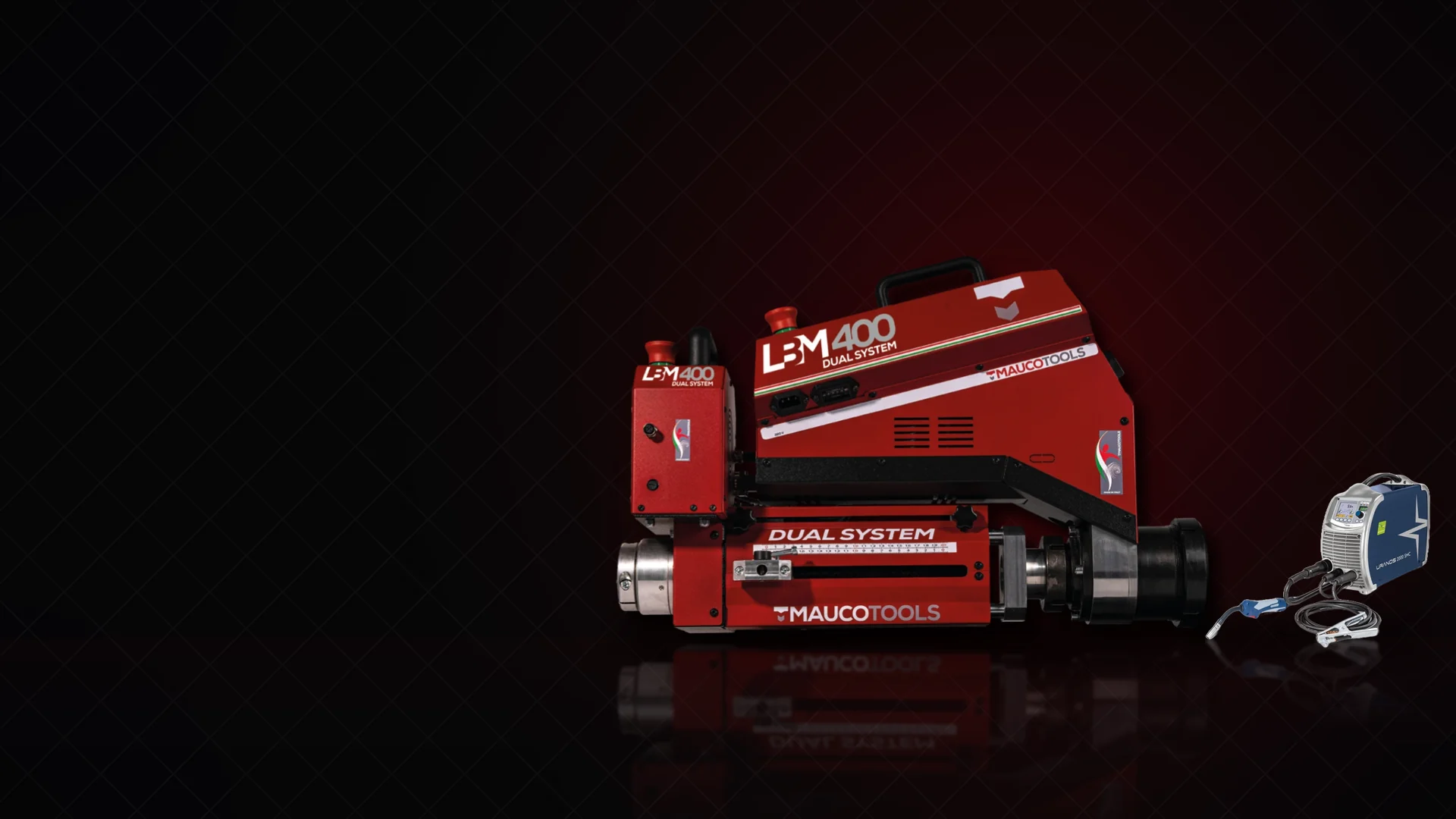
A Maucotools Dual System line boring machine with welder is built as two separate, independent modules. The rotation module (RT) drives tool rotation at variable speeds; the feed module (AV) controls automatic feed for both line boring and welding.
On the LBM250, LBM400 and LBM600 each module weighs around 17 kg: a single operator can carry and install it without hoists or cranes, even on an excavator arm. The independent motors allow simultaneous line boring and weld overlay, or line boring and facing, in the same set-up. The torch is mounted on the bar and deposits material with a controlled helical motion; once the overlay is complete, the boring tool is fitted and the bore is machined to size.
The catalogue models with integrated welding cover a range from Ø22 to Ø800 mm:
- LBM250 Dual System: line boring Ø22–250 mm, internal weld overlay 32–250 mm and external 22–250 mm, drilling and tapping 10–45 mm, 20 and 40 mm bars, 1.8 kW electric motor (220–230 V) or hydraulic. For buckets, excavator arms, bushes and pivots.
- LBM400 Dual System: line boring Ø42–400 mm, internal overlay 32–400 mm and external 22–400 mm, drilling and tapping 10–45 mm, 40 mm bar, 1.8 kW electric or hydraulic. For large earthmoving equipment, heavy industrial pivots and Oil & Gas.
- LBM600: line boring Ø42–600 mm, internal overlay 32–600 mm, for large pivots and hydroelectric plant.
- LBM600X and LBM800X: integrated welding, line boring Ø62–600 mm and Ø62–800 mm respectively.
- START160X: line boring Ø22–160 mm, internal overlay 32–160 mm and external 22–160 mm, automatic electromechanical feed, ready for weld overlay.
The line boring machines without integrated welding, OB200 (Ø22–200 mm), OB400 (Ø42–400 mm) and START160 (Ø22–160 mm), can be upgraded later with the conversion kits in the catalogue. The KC250 turns the OB200 into an LBM250 Dual System, the KC400 takes the OB400 to LBM400 and the KOK250 converts the START160 into an LBM250 with a motorised feed module.
For the welding side, Maucotools offers power sources compatible with all models: MPMIG, a single-phase multi-process inverter (MIG/MAG, synergic MIG, TIG DC Lift, stick electrode) with a 90 to 275 V supply, and URA2000, a MIG/MAG, TIG DC Lift and MMA inverter with a built-in two-roll wire feeder, 12.8 kg. The RWS “Intermittent welding” kit for LBM250, LBM400 and LBM600 lets you overlay only specific points of the bore by switching the welding on and off; for the hydraulic versions of compatible models the HPP power unit is available.
How to decide: five criteria
Five practical criteria help you work out which side of the line your work falls on.
1. How often you weld overlay
- Points to integrated welding: overlay is part of the routine work, because the bores that come in are almost always oversize and boring alone is not enough.
- Points to a separate welder: you usually bore a new bush or a seat that can still be recovered without adding material, and overlay comes up a few times a year.
2. Diameters to be machined
- Points to integrated welding: you often work on medium and large bores, where manual overlay followed by re-centring is laborious and the torch's automatic feed helps keep the deposit even.
- Points to a separate welder: the bores are mostly small, where a well-executed manual overlay is manageable. The guide to choosing a line boring machine by diameter and sector helps narrow down the model.
3. Travel between sites
- Points to integrated welding: you work on site, on machines standing idle in a quarry or a plant, where every extra piece of equipment to load and fit costs you in logistics.
- Points to a separate welder: the components come to the workshop, the welder is on the wall and the double set-up is done in comfortable conditions.
4. Equipment already available
- Points to integrated welding: you have no suitable welder, or you prefer a dedicated power source compatible with the torch mounted on the bar.
- Points to a separate welder: a reliable MIG/MAG is already in the workshop and you want to keep the initial outlay down; it is still worth reading what drives the portable line boring machine price to compare the two configurations.
5. Operator training
- Points to integrated welding: a single operator has to handle the whole cycle with a repeatable procedure, without depending on a welder's manual skill.
- Points to a separate welder: the crew includes an experienced welder who is always available, and the line boring machine is in the hands of someone who only does boring.
What to check before buying
Once the configuration is decided, a few practical checks remain.
- Welding diameters of the model. The line boring range does not coincide with the overlay range: LBM250 line boring Ø22–250 mm, internal overlay 32–250 mm and external 22–250 mm; LBM400 line boring Ø42–400 mm, internal overlay 32–400 mm and external 22–400 mm. The smallest and largest bores in your work must fall within the overlay range, not just the boring range.
- Compatibility with the MIG/MAG welder. If you plan to use a power source already in the workshop, check with technical support that it is compatible with the torch mounted on the bar; alternatively, the MPMIG and URA2000 power sources in the catalogue are compatible with all Maucotools portable line boring machines.
- Support and training. How initial training is delivered, who answers when problems arise, which spare parts to keep in stock.
- Kits and accessories. Bars in the required diameters, the RWS kit for intermittent welding, conversion kits if you are starting from an OB200, OB400 or START160.
Frequently asked questions
What is a line boring machine with welder?
A line boring machine with welder, or line bore welder, is a portable line boring machine that mounts the welding torch on the bar and controls its rotation and feed with its own motors, so it can carry out weld overlay inside bores and the subsequent boring to size without removing the machine from the workpiece. On Dual System machines the two modules, rotation and feed, have independent motors.
Can I use my own MIG welder?
It depends on compatibility with the torch mounted on the bar. Maucotools offers two MIG/MAG inverter power sources in its catalogue that are compatible with all its portable line boring machines, MPMIG and URA2000; using a different power source must be checked case by case with technical support before purchase.
Are overlay and line boring done in the same set-up?
Yes. The machine is centred and clamped only once; after the overlay the torch is replaced with the boring tool and the bore is machined to size on the same axis. In documented cases set-up took around 14 minutes and tolerances down to H7 were achieved, figures that depend on the workpiece and working conditions.
Is it worth it for just a few jobs a year?
If overlays really are rare and a suitable welder is already in the workshop, a line boring machine without integrated welding may be enough. It is still worth weighing up every double set-up, especially on site; if in doubt, the prudent route is a model that can be upgraded with a conversion kit.
Can a line boring machine without welding be upgraded?
Yes, for the models covered in the catalogue. The KC250 kit converts the OB200 into an LBM250 Dual System for line boring and overlay Ø22–250 mm, the KC400 converts the OB400 into an LBM400 (Ø42–400 mm) and the KOK250 turns the START160 into an LBM250 with a motorised feed module.
In short: a portable line boring and welding machine is the choice for those who weld overlay regularly, work on site and want the complete cycle in a single set-up; a line boring machine and a separate welder still make sense for those who restore bores rarely and already have a MIG/MAG in the workshop. Conversion kits let you postpone the decision without losing the investment.
To assess the right model for your diameters and your work, the contact form puts you in touch with Maucotools technical support. In every overlay job, welding safety rules and the instructions of the machine and power source manufacturers must be followed.