To choose a flange facing machine, start from the largest flange you need to face and the bore it must clamp in. Then decide how it mounts (ID or OD), how it is driven (by hand, electric, pneumatic, hydraulic or CNC) and what energy and area classification the site allows. The rest follows from those answers.
The expensive mistake is buying the wrong machine for the work you actually do: an undersized facer sends the job back to the workshop route, while an oversized one is slower to carry, slower to set up and ties up capital.
A flange facing machine, or flange facer, is a portable lathe that fixes to the flange and sweeps a single-point tool across the sealing face, restoring flatness and the gasket finish in place, without removing the flange from the line. For the process itself (damage types, procedure, final checks) see the complete guide to flange facing. This article covers the purchase decision, criterion by criterion.
Start from the diameter: facing range and clamping range
Every flange facer is defined by two ranges, and both must fit your flanges:
- Facing range: the smallest and largest face diameter the tool can sweep. The largest flange you service sets the minimum size of machine.
- Clamping range: on an internally mounted machine, the bore diameters it can grip. A machine that faces 19" but cannot clamp in your 2" bore is no use on that flange.
Measure the face to be machined, not the nominal pipe size. The sealing face of a flange is always larger than its nominal pipe size, so a list of "12-inch flanges" says little until it is turned into actual face diameters.
Size for the flanges you work on over a year, not for the single leak that triggered the purchase.
In the Maucotools ORBITRUE family of portable flange facing machines the model number is the maximum facing diameter in inches. Six sizes cover 1" to 80" (Ø 25–2032 mm); three are on sale now:
- ORBITRUE 19 Manual: faces Ø 25–482 mm (1"–19"), clamps in bores Ø 25–152 mm (1"–6").
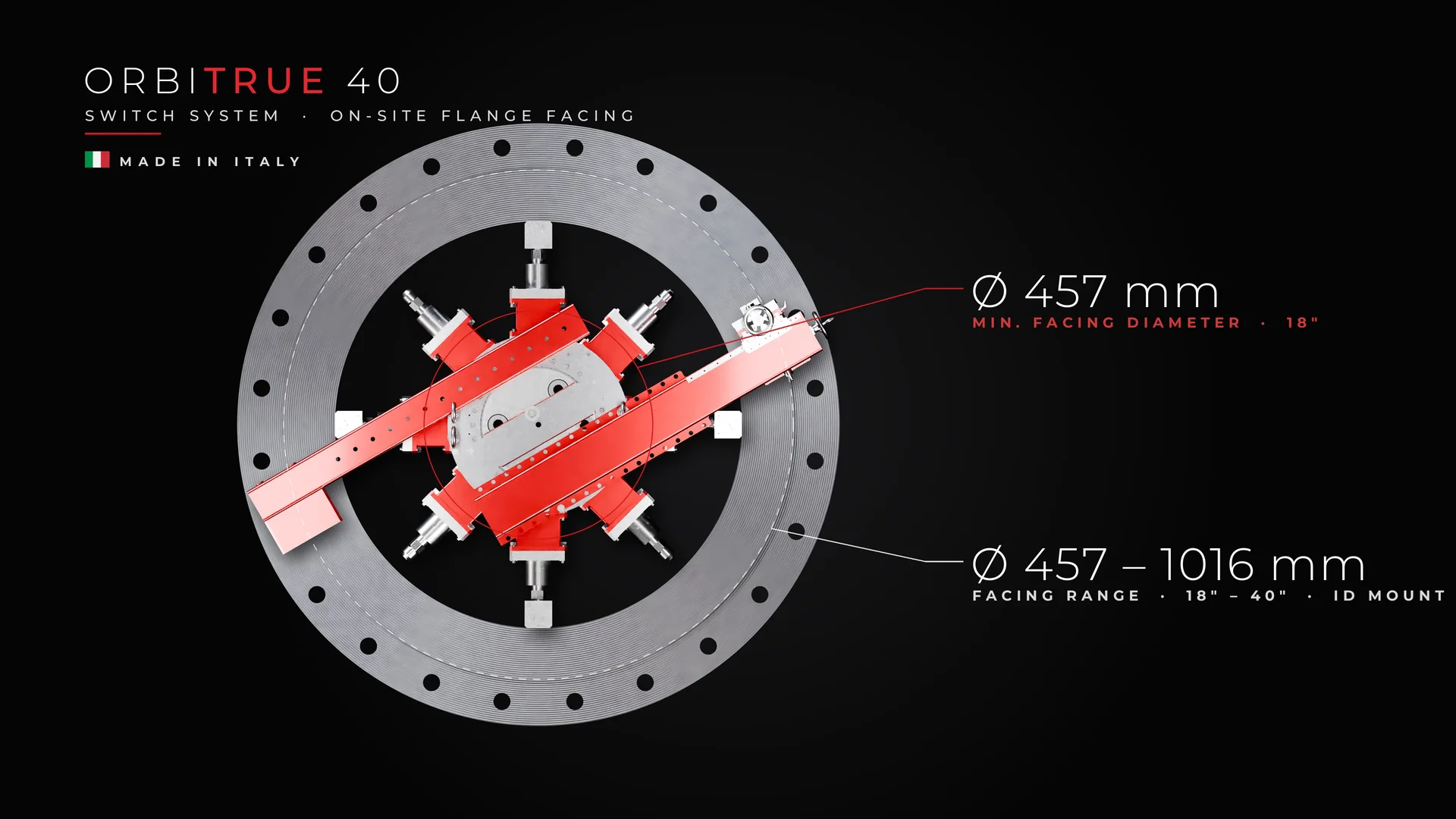
- ORBITRUE 40: faces Ø 457–1016 mm (18"–40").
- ORBITRUE 80: faces Ø 1016–2032 mm (40"–80").
The three ranges join up, with small overlaps at 18"–19" and at 40", so a flange anywhere between 1" and 80" falls into at least one of them. On the 40 and 80, ask for the clamping range of the arms and check it against your smallest bore before ordering.
ID mount or OD mount: where the machine takes its reference
How a facer fixes to the flange decides what it can reach and what it uses as its axis.
- ID mount (internal): the machine clamps inside the flange bore, and the bore becomes the axis of rotation. Nothing surrounds the outside of the flange.
- OD mount (external): the machine clamps around the outside of the flange or pipe, usually with an external frame or chuck, and turns around it.
ID mount is the right choice in most piping and vessel work, for three reasons:
- The face stays fully clear. With no external frame, the tool can travel from the bore edge to the outer diameter in one setup.
- The reference is the bore. The bore is concentric with the pipe or nozzle, so the faced surface ends up square to the flow axis.
- Less space is needed around the flange. Adjacent flanges, supports, walls and insulation often leave no room for a frame around the outside.
OD-mounted machines are typically considered when there is no usable bore, as on some blind flanges, or when the bore is obstructed. All ORBITRUE machines are ID mount: they clamp in the flange bore and turn around it.
Manual or motorised: choosing the drive
The drive should follow two facts about the site: what energy is available at the flange, and whether the area is classified for explosive atmospheres. Flange size comes into it too, because large faces mean long tool paths.
Manual: no power supply at all
A hand-operated facer needs nothing but the operator. It wins on small flanges, in tight spaces and where bringing in power, air or a hydraulic pack would take longer than the job. Large diameters, heavy stock removal and long series are work for a motorised machine.
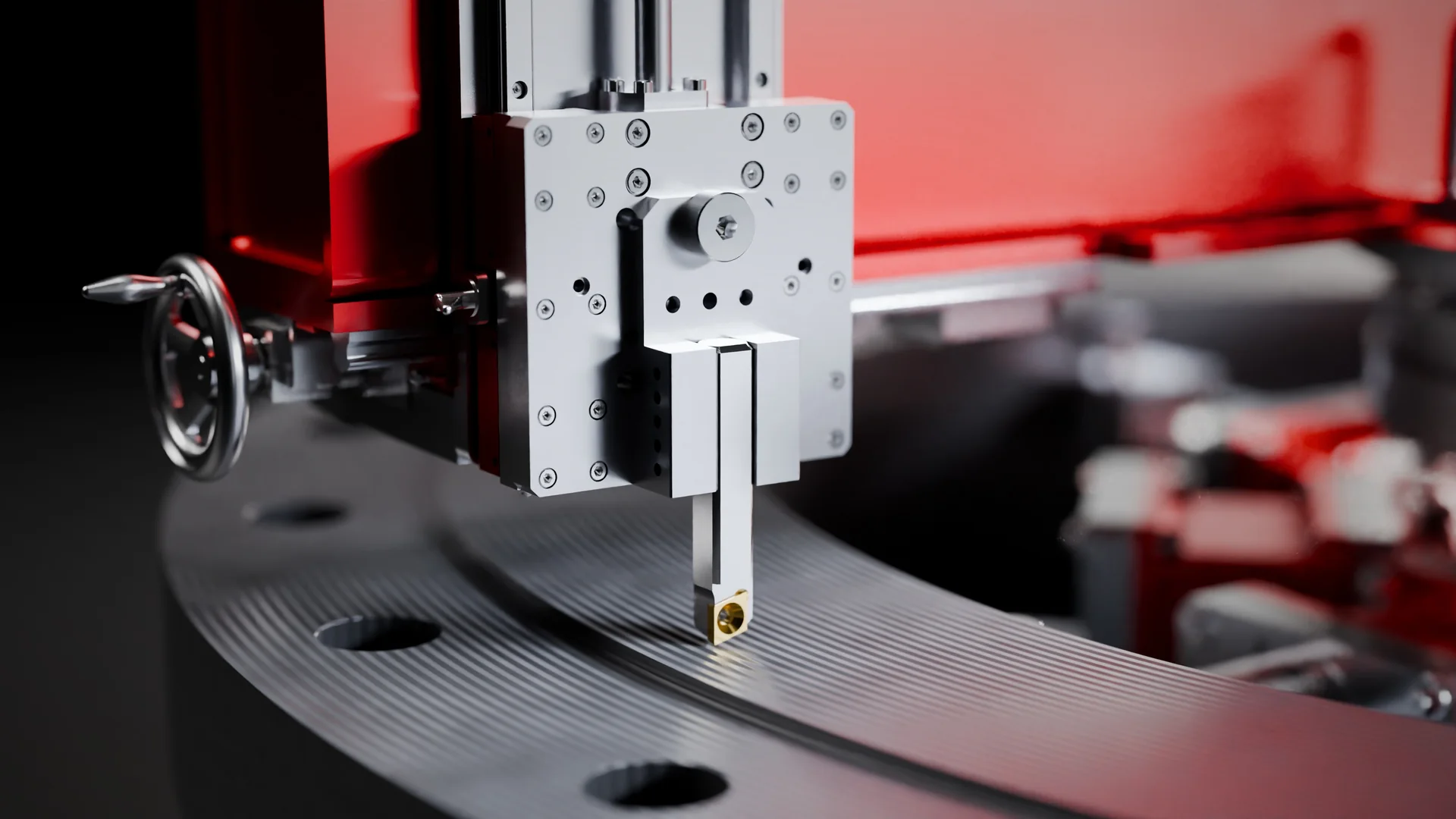
The ORBITRUE 19 Manual uses lead-screw radial feed driven by a hand knob, adjustable brass gibs and an indexable insert on a rigid holder, and leaves a continuous spiral (phonographic) finish. Its footprint is 331 × 191 mm.
Electric
The simplest powered option wherever mains power or a generator is available and the area is not classified. The electric ORBITRUE 40 uses a planetary gearmotor; the electric ORBITRUE 80 has a 2.5 kW gearmotor with planetary reduction and turns at up to 80 rpm.
Pneumatic
Compressed air is usually already on hand in refineries, petrochemical plants and shipyards, and pneumatic drives are the usual answer where electrical equipment is restricted.
Hydraulic
A good fit when a hydraulic power pack is already part of the site kit, for example in crews that also run hydraulic bolting tools.
CNC
For users who want the cycle under numerical control. Like the electric version, it is not intended for potentially explosive atmospheres.
Area classification (ATEX)
This is where many specifications go wrong, so it pays to be precise:
- The pneumatic and hydraulic versions of the ORBITRUE 40 and 80 are available in ATEX Category 3 execution, for Zone 2. Category 2 (Zone 1) is available on request.
- The electric and CNC versions are not for potentially explosive atmospheres.
- The ORBITRUE 19 Manual has no ignition source of its own. In a classified area it is used under the site's work permit.
- Whatever the machine, work in a classified area always requires the site's work permit. The equipment category is one input to that permit, not a substitute for it.
If the job sits in a classified area, put the zone, the available energy and the flange size in your first enquiry: you can send the flange details to Maucotools and get the right size and drive version proposed.
Work position, set-up and operations beyond facing
Horizontal or vertical
Flanges do not always face sideways. A flange on a horizontal pipe run or an exchanger channel has a vertical face; a nozzle pointing up has a horizontal one. Check that the machine is rated for both positions. The ORBITRUE 40 and ORBITRUE 80 mount horizontally or vertically, with clamping arms in the bore and the rotary module on a precision slewing bearing.
Feed and finish
The radial feed decides the finish. Automatic feed per revolution moves the tool by the same amount on every turn and leaves a continuous spiral groove; a manual override lets the operator take over when needed. The 40 and 80 have both. On the 19 Manual the feed is by hand, through the lead screw.
Chamfers, bevels and RTJ grooves
Facing is rarely the only operation. On the ORBITRUE 40 and 80 the tool head tilts through ±45°, so the same setup can face, chamfer and bevel without bringing a second machine. An RTJ grooving kit is available on request for the 40 and 80; it is not offered on the 19 Manual.
Transport and set-up
Ask how the machine reaches the flange and who installs it. A small manual facer arrives in a carrying case (the 19 Manual's includes the manual, the manufacturer's declaration and the test certificate) and is carried by one person. Large machines need lifting gear and a plan for vertical or elevated positions: confirm handling with the supplier and agree access with the site before the shutdown, not during it.
One platform, two machines
If your crew also bores large housings, look at the Switch System. With the Switch Kit, the ORBITRUE 40 or 80 becomes a large-diameter line boring machine, and changes back again. For the boring side of that decision, the guide to choosing a portable line boring machine applies the same diameter-first logic.
Questions to ask a flange facer supplier before you buy
- What are the facing range and the clamping range, and does my smallest bore fit?
- Is it ID or OD mount, and how much clearance does it need around and in front of the flange?
- Which drives are available, and which version is suitable for my area classification? Get the ATEX category in writing for the exact version quoted.
- Does it work in both horizontal and vertical positions?
- Is the radial feed automatic per revolution, manual, or both? What finish does it leave?
- Can the head chamfer and bevel? Is an RTJ grooving kit available?
- What is supplied with the machine: case, manual, manufacturer's declaration, test certificate?
- How is it lifted, carried and set up on site, and by how many people?
- Is there a technical datasheet for each size? Maucotools publishes one for the ORBITRUE 19 Manual, 40 and 80.
- Can the same platform do other work, such as line boring?
The ORBITRUE line-up: which size for which job
- ORBITRUE 19 Manual: 1"–19", hand-operated, no power supply. For maintenance teams and contractors facing small and medium flanges, often in tight spaces or with no energy at the flange.
- ORBITRUE 40: 18"–40", four drives, ±45° head, Switch System. For plants and contractors on mid-to-large flanges who need to match the drive to the site, including pneumatic or hydraulic versions for Zone 2.
- ORBITRUE 80: 40"–80", same architecture as the 40. For large exchanger, vessel and pipeline flanges, and for crews that want the Switch System route to large-diameter line boring. Details on the ORBITRUE 80 page.
Three further sizes in the family are coming soon to fill the intermediate steps.
FAQ
Is a flange facer the same as a flange facing machine?
Yes. Flange facer, flange facing machine and flange refacing machine all describe a portable lathe that machines a flange's sealing face in place; "refacing" stresses that the face is being restored.
What does ID mount mean on a flange facing machine?
An ID-mount machine clamps inside the flange bore, which becomes its axis of rotation. The outside of the flange stays clear, so the tool can cover the whole face in one setup and the result is referenced to the pipe axis. All ORBITRUE machines are ID mount.
Pneumatic or hydraulic: which flange facing machine for a classified area?
Both can work, so the choice usually comes down to what the site already has: compressed air or a hydraulic power pack. On the ORBITRUE 40 and 80, the pneumatic and hydraulic versions are available in ATEX Category 3 execution (Zone 2), with Category 2 (Zone 1) on request. In every case the site's work permit applies.
When is a manual flange facer enough?
When flanges are up to around 19", stock removal is light and there is no convenient energy source at the flange. The ORBITRUE 19 Manual covers faces from 1" to 19" with hand-knob radial feed and a continuous spiral finish. For larger diameters, heavy removal or long series, a motorised machine saves time.
Can one machine face flanges and line bore?
With the Switch System, yes. Adding the Switch Kit turns an ORBITRUE 40 or 80 flange facer into a large-diameter line boring machine, and it can be converted back.
Choosing a flange facing machine comes down to a short sequence: face diameter and bore first, then mounting, then a drive that matches the site's energy and classification, then the extras (vertical work, chamfers, RTJ grooves, line boring) that save a second machine. Answer those questions with your own flange list in hand and the choice usually narrows to one size.
To compare the three sizes and open each model's technical datasheet, start from the ORBITRUE flange facing machines page.