The flange bolt tightening sequence is the order in which the bolts of a flanged joint are tightened: in a star (criss-cross) pattern, in incremental passes up to the target torque, with a final circular check pass. Its purpose is to compress the gasket evenly and obtain a uniform preload: without this order, the correct torque alone does not guarantee a leak-tight joint.
On a flange the gasket only seals if it is crushed evenly around the whole circumference. Tightening the bolts one after another, clockwise and to full value, compresses it on one side and leaves it unloaded on the other: the flange tilts, the first bolts lose preload while the last ones are being tightened, and the joint leaks at the first thermal transient.
The cost of getting it wrong shows up at the pressure test. A leaking flange has to be opened up twice: it must be isolated, depressurised and dismantled; the gasket must be replaced, because once compressed unevenly it will not reseat; the studs must be inspected; then the whole job starts again, with the line upstream and downstream shut down in the meantime.
In Oil & Gas practice — refineries, pipelines, offshore platforms, skids, wind tower flanges — the flange tightening procedure follows an established scheme whose reference is ASME PCC-1, the guideline for the assembly of pressure-boundary bolted flange joints; the torque and preload values remain design data for the individual joint.
What the flange bolt tightening sequence is, and why torque alone is not enough
The flange bolt tightening sequence is a set of three rules: the order in which the bolts are tightened (star pattern, in diametrically opposite pairs), how many steps it takes to reach the target torque (incremental passes) and how the job is closed out (circular check pass). What you are after is not the torque itself, but three physical conditions on the joint.
- Uniform preload. Every stud must pull with the same force, within the tolerance of the specification. A bolt loaded more than its neighbours unloads them and concentrates the stress at a single point.
- Evenly compressed gasket. Spiral-wound, ring joint or flat, all gaskets need progressive, symmetrical compression to seat without local crushing or unloaded zones.
- Flange parallelism. The two faces must come together while staying parallel: tightening one side before the other tilts them, and subsequent tightening will not straighten them back.
Torque, even the right torque, is only the means by which you try to achieve preload. With torque control alone, the scatter in preload from one bolt to the next is in the order of ±25–30%, because friction on the threads and under the nut varies from stud to stud. The sequence and the passes reduce the effect of this scatter on the joint; they do not eliminate it. The full picture is in the complete guide to hydraulic bolting.
Before tightening: the checks that decide whether the joint seals
Preparation matters more than the tightening itself: this is the minimum checklist before fitting the wrench on the first nut.
- Studs, nuts and threads. Clean threads, free of dents, corrosion or paint; the nut must run by hand along the full length. A stud that has already yielded is replaced, not reused.
- New, centred gasket. Type and class as per specification, never reused, centred on the face. An off-centre gasket is the first cause of leakage on one side only.
- Flange faces. Clean, with no radial scoring and no residue from the previous gasket. Scoring beyond tolerance is machined out, not compensated for with torque.
- Uniform lubrication. The lubricant prescribed by the specification on the threads and under the nut face, on every bolt in the same way. This is the K factor (nut factor) that links torque to preload: changing lubricant, or lubricating only half the bolts, changes the preload for the same torque, as explained in the article on bolt tightening torque calculation.
- Alignment and parallelism. The flanges are brought together without using the bolts to pull them into line: piping misalignment is corrected at the supports, not with the wrench.
- Bolt numbering. With a marker, following the star pattern for that number of holes. On 24 or 32 studs, without numbers the sequence is lost by the second pass.
- Target torque or preload. A design value, not a site decision: it is defined by the flange designer, the gasket manufacturer, the OEM or the applicable procedure. The torque calculator returns an indicative value for sizing the tool, not a tightening specification.
The star pattern (criss-cross sequence): how to number the bolts
Star-pattern tightening loads the bolts in diametrically opposite pairs, working around the flange so that the load is distributed symmetrically. The logic is the same as a car wheel: one bolt, then the one opposite, then the one at 90°.
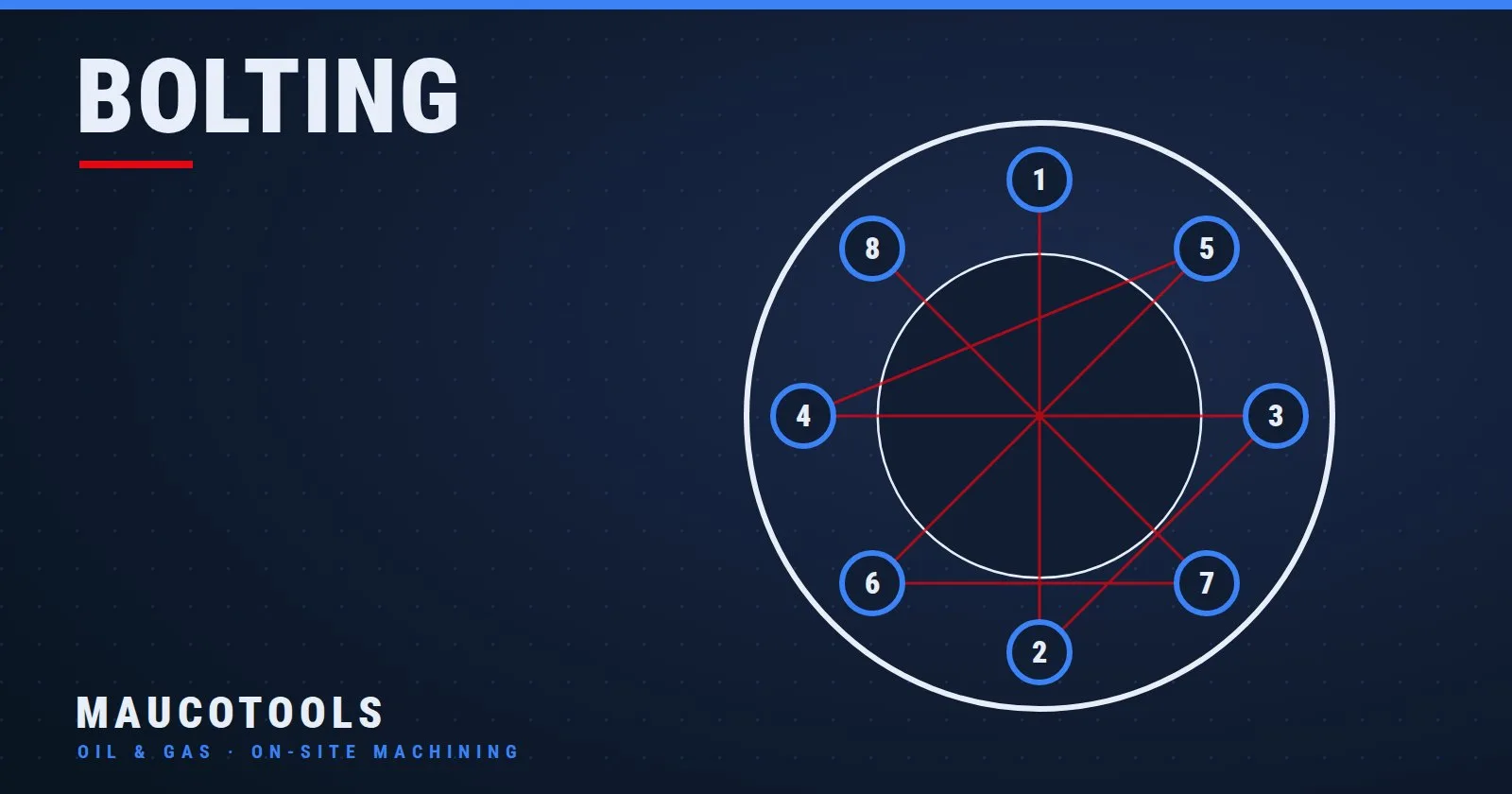
The numbering rule: number the holes clockwise from 1 to N; tighten bolt 1 and its opposite (1 + N/2), then the bolt at 90° and its opposite, then the intermediate bolts, always in opposite pairs, until the whole circumference is covered.
- 8 holes: 1 – 5 – 3 – 7 – 2 – 6 – 4 – 8.
- 12 holes: 1 – 7 – 4 – 10 – 2 – 8 – 5 – 11 – 3 – 9 – 6 – 12.
- 16 holes: 1 – 9 – 5 – 13 – 3 – 11 – 7 – 15 – 2 – 10 – 6 – 14 – 4 – 12 – 8 – 16.
With a large number of bolts the classic star pattern becomes slow to execute. For these flanges ASME PCC-1 allows alternative patterns that group the bolts by sector and reduce the walking distance, provided the load symmetry is maintained. The pattern, like the torque, is written into the site procedure before starting, not decided on the scaffold.
Incremental passes: why you never tighten in a single step
Taking the first bolt to 100% of the target torque while the others are still only hand-tight dumps the entire load onto one point of the gasket and tilts the flange. This is why the torque is reached in at least three passes, each a complete star-pattern round, plus one check pass.
- Snugging pass. Nuts run down by hand, then a first star-pattern pass at reduced torque — indicatively 30% of the target — to bring the flanges into parallel contact on the gasket.
- Intermediate pass at 60%. Again in star pattern, same numbering. This is the pass in which the gasket seats the most and the bolts already tightened lose some load: that is normal.
- Pass at 100%. Star pattern, at the target torque. The bolts tightened first have given up load during the later passes and now recover it.
- Circular check pass. At 100%, bolt after bolt clockwise starting from 1. Repeated until no nut turns any further under the wrench: at that point the joint is at uniform preload within the limits of the method.
The percentages illustrate the principle, not the specification: the number of passes, the intermediate values and the final torque are defined by the joint procedure — flange designer, gasket manufacturer, OEM or applicable standard — and every torque figure quoted here is an indicative value for sizing the tool, not a tightening specification. With a hydraulic wrench each pass is set by the pressure at the power pack, according to the calibration chart: repeatable and recordable.
Where the procedure requires it — gaskets prone to relaxation, joints operating at temperature — a hot re-torque after settlement is added: after the first thermal cycle, or after the time stated in the specification, the circular pass at 100% is repeated with the plant in a safe condition, to recover the load lost during the first hours of service.
Simultaneous tightening on large flanges: wrenches in parallel and tensioning
On large-diameter flanges — pipelines, vessels, wind towers — the star pattern with a single wrench is slow and, with many bolts, does not make up for the load the first studs lose while the last ones are being tightened. The practice, also covered by ASME PCC-1, is simultaneous tightening: two hydraulic wrenches at 180° or four at 90°, fed by the same power pack, tightening opposite bolts together. The incremental passes stay the same.
Maucotools MT-HTW square-drive hydraulic torque wrenches cover from 98 to 136,312 Nm across 12 models, with ±3% repeatability and a 360° swivel head, and are supplied calibrated with a torque certificate: the certificate lets you record the pressure of each pass in the joint documentation. For a shutdown of defined duration, the crew can also be equipped with rented hydraulic torque wrenches in the sizes called for by the bolting plan.
When the specification calls for accurate preload, or the studs are large in diameter, torque is not enough, because the scatter due to friction remains. You move to tensioning: MT-BT hydraulic bolt tensioners stretch the stud within its elastic range with pure axial pressure, with no torsion and no friction under the nut, and with multi-tensioning plus load cells they connect to a manifold for simultaneous tightening at 100% coverage (one tensioner per bolt, a single pass) or 50% coverage (one tensioner every other bolt, two passes). The prerequisite is that the stud protrudes beyond the nut by at least one diameter: with studs flush with the nut, you go back to the wrench.
The most common mistakes in star-pattern tightening
- Non-impact sockets on the hydraulic wrench. Ratchet sockets cannot take the torque of a hydraulic wrench and crack; you need MT-IS alloy-steel impact sockets, with retaining pin hole and o-ring, in the correct drive size.
- Dry or dirty threads with the torque for lubricated threads. The specified torque assumes a K factor: without the intended lubricant the bolt is left under-loaded; a dry-thread torque on a lubricated thread overloads it.
- Skipping passes. Going straight to 100% to save time: tilted flanges and a gasket crushed on one side.
- Reusing yielded studs. A stud stretched beyond its elastic limit will not recover preload: it is replaced, not re-tightened.
- Not numbering the bolts. Without numbers the sequence is lost, especially with wrenches working in parallel.
- No final circular pass. Stopping at the last star-pattern pass leaves the first bolts at a lower load than the later ones: the circular check is there to bring them back up.
- Reused gasket. A gasket that has already been compressed has lost its ability to seat: it will not hold at the pressure test.
- Wrench at the limit of its range. The size is chosen so that the target torque falls in the middle part of the range, not at the extreme where the wrench works with no reserve.
Frequently asked questions
What is star-pattern tightening of a flange?
It is the tightening order in which the bolts are tightened in diametrically opposite pairs, moving 90° each time and then to the intermediate bolts, until the whole circumference is covered. On an 8-hole flange the order is 1-5-3-7-2-6-4-8. It compresses the gasket symmetrically and keeps the flanges parallel during tightening.
How many passes does it take to tighten a flange?
At least three incremental star-pattern passes — indicatively 30%, 60% and 100% of the target torque — plus a final circular pass at 100%, repeated until no nut turns. The number of passes and the intermediate values are set by the joint procedure; with delicate gaskets or large studs the specification may call for more.
Can a flange be tightened with a manual wrench?
On small flanges and low torques, yes, with a calibrated torque wrench and always in star pattern with incremental passes. When the torque can no longer be handled safely by hand, or has to be repeated identically on dozens of bolts, the square-drive hydraulic wrench becomes the standard: the torque is set by pressure and repeated identically on every bolt.
What changes with a hydraulic bolt tensioner?
The tensioner applies no torque: it stretches the stud with axial pressure and the nut is run down at zero torque, so there is no friction scatter. The star-pattern sequence is replaced by simultaneous tightening of all the studs (100% coverage) or of half of them in two passes (50% coverage). It does require the stud to protrude beyond the nut by at least one diameter.
Is a re-torque needed after start-up?
It depends on the joint: gaskets prone to relaxation and flanges operating at temperature lose preload during the first hours of service. Where the procedure requires it, the circular pass at 100% is repeated after the first thermal cycle, with the plant in a safe condition. The re-torque is written into the bolting plan and recorded like the previous passes.
A flange seals when the preload is uniform, the gasket is evenly compressed and the faces have stayed parallel: star pattern, incremental passes and a circular check pass are the way to get there with torque. Target torque, pattern and number of passes are written into the procedure before anyone climbs onto the joint, and every pass is recorded.
To size wrenches, sockets and tensioners against the bolting plan for a shutdown, the Maucotools bolting range is the starting point for requesting a quotation on the configuration the joint requires.
Flange tightening on pressurised plant must be carried out in accordance with site safety rules, the approved joint procedure and the tool manufacturer's instructions.