Hydraulic bolting is the controlled tightening of bolted joints using hydraulic torque wrenches, which apply high, repeatable torque to bring every stud to the preload the joint designer intended. On the flanges of refineries, process skids, offshore platforms and wind towers, it is the reference method whenever the required torque exceeds what a hand tool can deliver with precision.
The subject concerns anyone accountable for the integrity of a joint: maintenance managers, piping supervisors, contractors working planned shutdowns. A badly tightened flange does not announce itself right away: it passes visual inspection, then starts leaking at the first thermal or pressure excursion — and at that point the cost is not the gasket, but breaking the joint back open with the plant down.
This guide walks the entire controlled-bolting chain: why torque is only a means of achieving preload, which tools you need and when, how to size the wrench and the socket, how much torque to set and what procedure to follow when applying it to the joint.
Why tightening "by feel" gets expensive
On a flange closed with a slugging wrench, a cheater pipe or plain muscle, nobody knows how much preload ended up in each stud. Some studs are left almost slack, others have been taken past their limit: the gasket is compressed unevenly, the flange goes out of alignment and the joint runs crooked from day one.
The consequences take three recurring forms. The first is leakage: a leak on a process line means depressurizing, purging, dismantling, replacing the gasket and re-tightening — often with the line out of service. The second is component damage: studs yielded by over-tightening, due for replacement at the next opening, and scored sealing faces. The third is the least visible: joints that hold at the pressure test but sit right at the limit, and let go at the first transient.
The common denominator is that the real cost almost never lies in the tool or the fasteners, but in plant downtime and the hours spent re-opening the joint. That is why controlled bolting is not a laboratory refinement: it is preventive maintenance applied to the flange.
What controlled bolting is: torque, friction, preload
Controlled bolting is the process of bringing every threaded fastener in a joint to a defined, documented, repeatable preload. Preload — the tensile force in the shank of the bolt — is what keeps the gasket compressed and the joint closed; the torque applied to the nut is merely the means of generating it.
The conversion from torque to preload is governed by friction: most of the applied torque is dissipated under the nut face and in the threads, and only a fraction is turned into useful bolt stretch. That is why two identical bolts, tightened to the same torque under different friction conditions, reach very different preloads: with torque control alone, preload scatter is typically in the region of ±25–30%.
Controlled bolting exists precisely to govern that scatter: a tool with repeatable torque, a defined lubrication condition, the correct sequence and passes, and verification criteria. It is the approach codified by the industry references, chiefly ASME PCC-1 for the assembly of gasketed flange joints and VDI 2230 for the calculation of bolted connections.
The tools: when hydraulics are needed
Hand torque wrench, torque multiplier, impact wrench: the limits
The hand torque wrench remains the right tool for modest torques and small fasteners, but on the studs of a line flange it soon runs out of stroke and ergonomics. The torque multiplier extends the working range, at the price of bulk and cycle times that grow with the required torque.
The impact wrench, finally, is fast but it is not a control tool: the torque actually transmitted depends on the air supply, the pulse duration and the compliance of the joint, and is neither measured nor recorded. It is fine for running nuts down, not for certifying a tightening.
The hydraulic torque wrench: high, repeatable torque
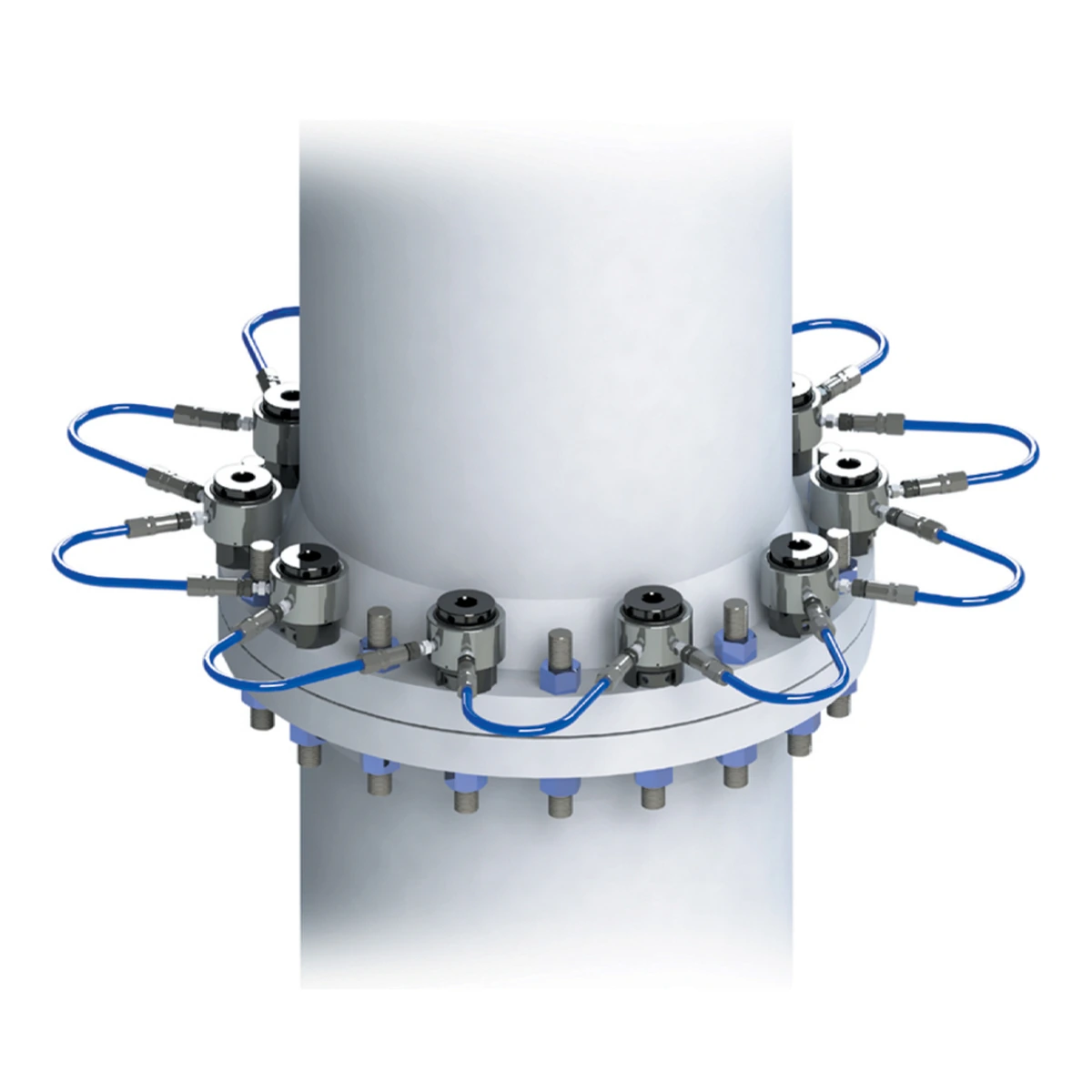
The hydraulic torque wrench turns the approach on its head: torque is set as pressure on the power pack, the cylinder converts it into rotation of the square drive, and a reaction member transfers the effort to a solid point nearby, typically an adjacent nut or the flange itself. The result is high torque with repeatability in the region of ±3%, independent of the operator: the same value on the first stud and the last one on the flange. It is the tool that makes incremental passes over dozens of studs practical — and simultaneous work with several wrenches on large flanges.
The MT-HTW range at a glance
The Maucotools MT-HTW hydraulic torque wrenches cover, across 12 standard models, a torque range from 1,040 to 136,312 Nm, with square drives from 3/4" to 3-1/2" and torque repeatability of ±3%. The body is high-strength light alloy, with a reaction cassette and a head and reaction attachment that both swivel through 360° to match the wrench to the geometry of the joint. Every wrench is calibrated and supplied with a torque certificate, and works with the high-pressure hydraulic power packs and with the MT-IS impact sockets.
On the five mid-range sizes, three special executions are available, bringing the total to 27 models: -E with an external spline for tight radial clearances, -U uniswivel with a 360°×180° articulated joint for pipework and awkward orientations, and -Q with in-line reaction, which does away with the reaction arm where no bearing point exists. The full model overview is on the MT-HTW hydraulic torque wrenches page.
In practice, choosing a hydraulic torque wrench comes down to two criteria: the maximum torque the joint requires — working in the middle of the wrench's range, not at its limit — and physical access to the joint, which decides between the standard, -E, -U or -Q execution.
The right socket matters as much as the wrench
The weak link on many job sites is not the wrench, but what sits between the wrench and the nut. Chrome-plated hand sockets are not designed for the shock and torsional loads of an impact tool or a hydraulic wrench: they can crack and shatter, with a direct risk to the operator. On these tools, only impact sockets may be fitted.
MT-IS impact sockets are made of hot-forged, heat-treated chrome-molybdenum alloy steel, with ISO tolerances, a retaining-pin hole and an O-ring for secure fastening on the drive. The range covers drives from 3/8" to 3-1/2" plus the spline #5, and sizes from 8 to 235 mm, in metric and imperial, with hex, bi-hex and double-square profiles, standard and deep versions, a thin-wall series for tight recesses and power sockets for turbines and very high torques; extensions, adapters, universal joints and cased sets complete the range. The part number is self-explanatory — MT-IS, drive size in hundredths of an inch, size across flats in mm, plus the -D, -BH, -BS and -TW suffixes — and guided selection is on the MT-IS impact sockets page.
Working out which impact socket to use — profile, drive, length, wall thickness — deserves the same rigor as choosing the wrench: the wrong socket throws away the precision of the tool upstream and introduces a risk no procedure can compensate for.
How much torque do you need?
The most frequent question in bolting — how to calculate tightening torque — has a precise chain of answers. You start from the bolt, move to the class or grade of the material — 8.8, 10.9, 12.9 for metric fasteners, ASTM B7, L7, B16 and B8 for plant bolting — which sets the yield load. You then choose the percentage of yield to work at and, the decisive step, the K factor describing friction: roughly ~0.20 dry, ~0.11 with MoS₂ pastes, ~0.10 with PTFE lubricants. Out of that comes the torque, in Nm and in ft·lb.
A worked example gives a feel for the magnitudes involved: an M30 class 10.9 bolt, lubricated with MoS₂ and tightened to 65% of yield, requires 1,083 Nm — already beyond the comfortable reach of hand tools. It also demonstrates how much lubrication weighs: the same bolt tightened dry, with K going from ~0.11 to ~0.20, would need nearly double the torque for the same preload.
To run the numbers on your own case there is the Maucotools torque calculator: enter the bolt, class or grade, lubrication and target percentage of yield, and for torques between 98 and 136,312 Nm the calculator automatically matches the right MT-HTW wrench.
The value obtained this way is indicative and serves to size the tool: it is not a tightening specification. The torque to apply to a real joint is defined by the flange designer, the gasket manufacturer, the OEM or the applicable codes (ASME PCC-1, VDI 2230); and with torque control alone, preload scatter still remains at ±25–30%.
Procedure is half the job
With the right torque and the right tool you can still ruin a joint: the gasket responds to how the load is distributed over time, not just to the final value. That is why the flange tightening sequence is run in a star pattern, alternating diametrically opposite bolts according to a numbering defined before starting, so that the flange comes down parallel onto the gasket.
The load is applied in incremental passes — for example 30%, 60% and 100% of final torque — closed out by a circular check pass at 100%, which recovers the relaxation induced by tightening the neighboring bolts. ASME PCC-1 codifies this approach and the alternative patterns it permits. On large flanges, two or four hydraulic wrenches are run simultaneously on opposite bolts: at that point the repeatable torque of the hydraulic wrench is no longer an option, but the very premise of the procedure.
The most common bolting mistakes
The same mistakes come up in almost every analysis of joints that have failed:
- Non-impact sockets on hydraulic or impact tools: a shattering hazard, plus play that degrades the tightening.
- Torque applied to dirty or dry threads when the calculation assumed a lubricated K: actual preload collapses even though the gauge reads the expected value.
- Tightening in a single pass to 100% going around the flange: gasket loaded unevenly, flange out of alignment.
- No final check pass: the first bolts tightened relax while the last ones are being tightened.
- Reusing yielded or corroded studs, which can no longer reach the specified preload.
- Poorly seated reaction: a reaction arm bearing on an unstable edge falsifies the tightening and puts the operator's hands at risk.
- Calibration ignored: a wrench out of calibration shifts the entire flange out of specification, systematically.
FAQ
What is the difference between tightening torque and preload?
Preload is the tensile force in the bolt that keeps the joint closed; torque is the twisting moment applied to the nut to generate it. The link between the two runs through friction: at the same torque, different friction conditions produce different preloads, with a typical scatter of ±25–30% when torque alone is controlled.
How much does lubrication affect the torque to apply?
Enormously: the K factor moves roughly from ~0.20 dry to ~0.11 with MoS₂ pastes and ~0.10 with PTFE lubricants. For the same required preload, the torque with a good lubricant is about half the dry value: that is why the lubrication condition is part of the tightening specification, not an operator's choice.
When do you need a wrench with in-line reaction (-Q execution)?
When there is no valid bearing point around the joint for the reaction arm: isolated bolts, or geometries offering no adjacent nut or solid surface. The -Q execution of the MT-HTW range takes the reaction in line, eliminating the arm and the risks of an improvised bearing point.
Can ordinary sockets be used on a hydraulic wrench?
No. Chrome-plated hand sockets are not rated for the loads of a hydraulic or impact tool and can shatter in service. You need impact sockets in heat-treated alloy steel, secured with a retaining pin and O-ring, such as the MT-IS series.
Who defines the correct tightening torque for a flange?
The flange designer, the gasket manufacturer, the equipment OEM or the applicable codes, first among them ASME PCC-1 and VDI 2230. Calculators and tables serve to size the tool and set up the job; they do not replace the joint's tightening specification — in doubtful cases, put the question to the designer or to a technical contact.
Controlled bolting is not a single purchase but a chain: a defined preload, torque calculated on the real K factor, a repeatable hydraulic wrench, the correct impact socket, a star-pattern sequence and incremental passes. Every missing link puts the joint back in the gray zone of "it should hold" — which on a process line is paid for in hours of downtime.
To set up or renew a plant's bolting equipment, the Maucotools bolting range brings together wrenches, sockets and accessories, with the option of requesting a quotation on your specific configuration. For field work, site safety rules and the tool manufacturer's instructions always apply.