The tightening torque for a bolt is calculated with the formula T = K·D·F: the nut factor K, the nominal diameter D, and the preload F you want to develop in the shank. The number it produces is indicative — it is there to size the tool, not to replace the joint's tightening specification.
Anyone searching for a "bolt torque chart" expects a single figure per diameter. The trouble is that no such figure exists: the correct torque for the very same bolt can nearly double depending on lubrication, and it shifts again with the material class, the percent of yield you are working to, and whether the stud has been reused. A static table freezes all of these variables without declaring them.
This article walks the full calculation chain — from tensile stress area to nut factor K — with two examples worked through to the result, one metric and one imperial. It is the same method implemented in the Maucotools torque calculator: once you understand the method, running the numbers on a real case takes thirty seconds.
Torque is not the goal — it is the means
A bolted joint holds because of preload: the tensile force that tightening induces in the bolt shank, keeping the parts — or the gasket — clamped together even under external load. Tightening torque is the twisting moment applied to the nut to generate that preload: it is the quantity you control in practice, because measuring the tension in the shank directly is far more expensive.
The path from torque to preload is anything but direct, though: most of the applied torque is consumed by friction — in the threads and under the nut face — and only what remains becomes useful tension. That is why every serious calculation includes a friction factor, and why the same number of Nm can produce very different preloads in two apparently identical bolts. For the bigger picture — tools, procedure, verification — see the complete guide to controlled bolt tightening; here we get into the calculation itself.
The calculation chain: T = K·D·F
The working formula is simple: T = K·D·F, where T is the torque, K the nut factor, D the nominal bolt diameter, and F the target preload. All the difficulty lies in determining F and K honestly. The full chain runs from the bolt to the torque in four steps.
1. From the bolt to the tensile stress area Aₛ
The first input is the thread's tensile stress area (Aₛ): the effective area working in tension, smaller than the nominal cross-section because the thread removes material. It is tabulated for every thread form, metric or unified inch, and it underpins everything that follows: the allowable preload is the product of Aₛ and the material's yield strength, reduced to the percentage you choose to work at.
2. From the class or grade to the yield strength
For structural metric fasteners the material is identified by its property class: 8.8, 10.9, 12.9. Each class sets a reference yield strength, with one detail that is often overlooked: for class 8.8 the reference value changes above M16, so an M20 8.8 is not calculated with the same value as an M12 8.8.
For plant and piping fasteners the ASTM grades apply: A193 B7, the most common on flanges and pressure equipment, with yield strengths defined by diameter range (as the diameter grows, the reference value drops); A320 L7 for low-temperature service; A193 B16 for high temperatures; A193 B8 and B8M for stainless steels. Same diameter, different grade: different torque.
3. The target percent of yield
No tightening job takes a bolt to 100% of yield: you work to a fraction of it, leaving margin for external loads and for the scatter of the method. The commonly used values are working conventions, not standards: 65% as the generic case, around 50% on a gasketed flange joint — where the gasket, not the bolt, dictates the load —, around 55% when the stud is being reused, up to 90% in torque-angle tightening, where control no longer relies on torque alone. They are starting points to be confirmed against the joint specification, never rules to apply blindly.
4. The nut factor K: lubrication changes everything
K condenses all the friction in the system into a single number, and it is the variable with the biggest impact on the result. Typical indicative values: ~0.20 for dry threads, ~0.11 with molybdenum disulfide (MoS₂) pastes, ~0.10 with PTFE-based lubricants; anti-seize compounds sit in between. In practical terms: between a dry thread and a well-lubricated one, the torque needed for the same preload nearly halves. That is why K is never picked by feel: you use the value for the lubricant actually applied on the joint, and if the specification mandates a different one, the specification wins.
Two worked examples, from bolt to newton meters
Metric case: an M30 class 10.9 stud, threads lubricated with MoS₂ paste, target 65% of yield — the generic case. The chain: tensile stress area of the M30, yield strength of class 10.9, preload at 65%, torque with K ≈ 0.11. Result: 1,083 Nm. A value of this order is already beyond the comfortable working range of manual tools and puts the job squarely in hydraulic torque wrench territory.
Imperial case: a 1-1/2"-8UN stud in ASTM A193 B7 — the typical combination on process flanges — with anti-seize and a conservative target of 50% of yield, as on a gasketed flange joint. The tensile stress area of the 1-1/2"-8UN is about 1.49 in²; applying the B7 yield strength for that diameter range and the intermediate K of anti-seize, the resulting torque is 1,273 ft·lb, roughly 1,726 Nm.
There is no point in redoing these steps by hand every time: the Maucotools torque calculator implements the entire chain — bolt, class or grade, lubrication, target percentage — and returns the torque in Nm and ft·lb plus the preload in kN, with an editable nut factor K for when the specification mandates a different one.
Same torque, two different preloads
The structural limit of the method needs stating plainly: with torque control alone, the scatter on preload is typically ±25–30%. Two studs tightened to the exact same value can end up one well below and the other well above the intended preload. The main causes:
- thread condition: rust, dirt, local damage;
- uneven lubrication, or lubrication different from what the calculation assumed;
- friction under the nut: washer, finish of the bearing surface;
- reuse of studs that have already worked near their limit;
- how the torque is applied: jerky or intermittent tightening.
Scatter cannot be eliminated — it is managed: threads cleaned and lubricated as calculated, a repeatable tool, and above all the flange tightening sequence and passes, which distribute the load progressively across the whole bolt circle. Where the residual scatter is not acceptable, you move to methods that control a quantity closer to the preload itself, such as torque-angle tightening or bolt tensioning.
Who defines the "right" torque
Everything above is there to explain the method and to size the tool. It does not produce the tightening specification, and the distinction is not red tape: it is the reason this page contains no torque-per-diameter table. A table ages, circulates detached from its assumptions, and ends up used as an implicit specification on joints that have nothing to do with the conditions it was written for.
Every torque quoted on this page is an indicative value for tool sizing, not a tightening specification. The torque to apply on a real joint is defined by the flange designer, the gasket manufacturer, the equipment OEM, or the applicable standards — first and foremost ASME PCC-1 for the assembly of gasketed flange joints and VDI 2230 for the calculation of bolted connections. Where no specification exists, the question goes to whoever designed the joint — it is not answered with a table value.
From the number to the tool
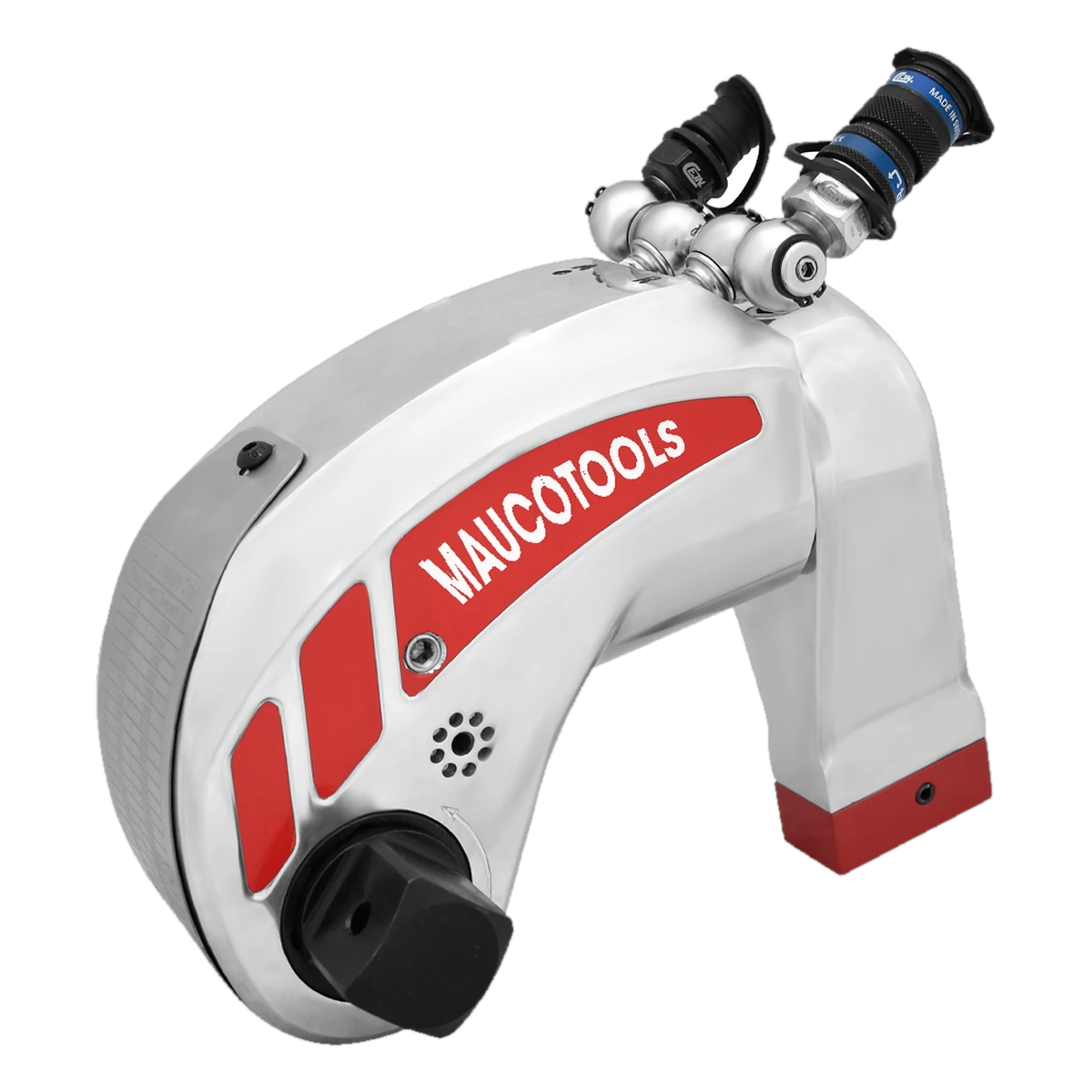
Once you have the torque, one step remains: choosing a hydraulic torque wrench able to deliver it with margin. The calculator automates this too: for torques between 98 and 136,312 Nm it automatically matches the appropriate MT-HTW wrench model; outside that range it suggests contacting the engineering department.
The range of MT-HTW hydraulic torque wrenches covers, across 12 models, a span from 1,040 to 136,312 Nm with ±3% repeatability — and it is that repeatability that turns the calculation into more than an exercise: an accurate calculation executed with an imprecise tool is still an imprecise tightening job. Impact sockets and accessories to complete the setup are in the bolting range.
FAQ
What is the tightening torque for a class 8.8 or 10.9 bolt?
There is no single value per class: the torque depends on the diameter, the nut factor K, and the target percent of yield. The same 10.9 bolt, dry or lubricated with MoS₂, requires very different torques for the same preload; and for class 8.8 the reference yield strength changes above M16. The calculation has to be done for the specific case, with the K of the lubricant actually used.
Is there a bolt torque chart valid for every case?
No. Every table freezes a nut factor K and a percent of yield, often without declaring them: used outside those assumptions it can produce torques far from the correct one. An explicit calculation is better, with K and the target percentage chosen and visible — and in any case, where a tightening specification exists for the joint, the specification has the final word.
What does tightening to 65% of yield mean?
It means sizing the preload at 65% of the bolt's yield strength, leaving margin for external loads and for the scatter of the method. It is the working convention for the generic case: on a gasketed flange joint you typically come down toward 50%, with reused studs around 55%, while torque-angle tightening goes up to 90% because it controls a different quantity than torque alone. None of these values is a standard: they are starting points to be confirmed against the specification.
How do you convert Nm to ft·lb?
1 ft·lb ≈ 1.36 Nm. In practice the conversion should not be done by hand: the calculator returns both units, plus the preload in kN — useful when the specification is in imperial units and the instrumentation is calibrated in metric, or vice versa. In the worked example above, 1,273 ft·lb corresponds to roughly 1,726 Nm.
Stripped to its essentials, bolt tightening torque calculation is a chain of four explicit choices: tensile stress area, material, target percentage, nut factor K. Make them explicit and you get a defensible number and a tool sized with margin; copy a value from a table and you inherit assumptions nobody has verified.
The fastest way to apply the method to your own joint is the torque calculator: thirty seconds from bolt to torque, with automatic wrench matching. For binding values, the joint specification and the applicable standards remain the authority.