A hydraulic torque wrench is selected starting from the maximum torque the joint requires, with enough margin to place the target value in the middle of the tool's range. Only then do you look at access to the nut, the square drive and the impact socket. Torque, available space and reaction point decide the model before any other consideration.
On a piping flange, a pressure vessel or the base of a wind turbine tower, hydraulic tightening answers a specific problem: applying the same torque to every bolt, in tight spaces, without depending on operator strength. The wrong wrench, however, turns that advantage into a risk: it works at its limit, does not fit on the joint, or transfers the reaction where it should not.
The full guide to flange tightening with hydraulic bolting starts from the joint; here we follow instead the order of decisions a maintenance engineer makes when facing a tightening specification: torque, access, drive and socket, pump unit, calibration check.
Start from the torque, not the bolt
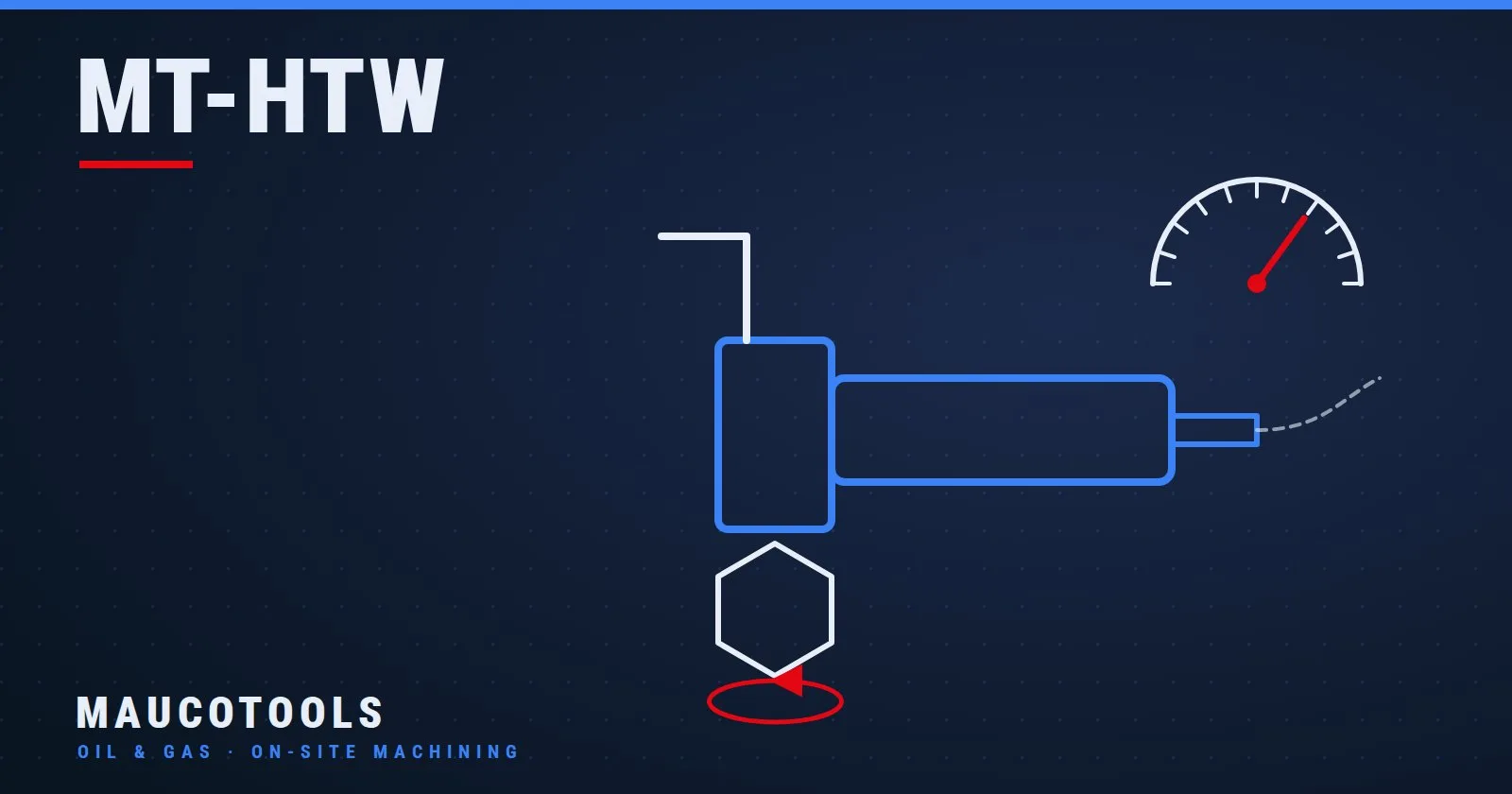
A hydraulic torque wrench is a tightening tool in which a cylinder, fed by a high-pressure pump unit, rotates a square drive through a ratchet mechanism; the torque delivered depends on the set pressure, and the body transfers the reaction force to a fixed point adjacent to the nut. It is neither a manual torque multiplier nor an impact wrench: the torque is controlled, repeatable and certified.
The first figure you need is not the bolt diameter but the tightening torque required by the joint. That value is defined by the flange designer, the gasket manufacturer, the equipment OEM or the applicable procedure (ASME PCC-1, VDI 2230). Two flanges with the same bolt can require different torques because of material, lubricant and gasket.
If the specification is missing, the torque calculator with the T = K·D·F method gives an order of magnitude that is useful for sizing the tool. Its disclaimer applies to the letter:
Indicative value for sizing the tool — not a tightening specification. The tightening torque is a design parameter of the joint: it is defined by the flange designer, the gasket manufacturer, the OEM or the applicable procedure (ASME PCC-1, VDI 2230). With torque control alone, preload scatter is in the order of ±25–30%.
Rule of thumb: the target value must fall in the middle band of the wrench's range, not at the upper limit. A wrench that always works at maximum pressure stresses seals and ratchet, leaves zero margin for a lubricant other than the one specified, and has no reserve if the procedure calls for a final check pass at increased torque.
An example using the calculator's values: an M30 grade 10.9 stud lubricated with MoS₂, at 65% preload, gives about 1,083 Nm (indicative value for sizing the tool, not a tightening specification). In the MT-HTW series the MT-HTW-1250 reaches 1,236 Nm and would be working almost at full scale; the MT-HTW-1800, with a 177–1,795 Nm range, places that value in the middle band and is the correct match.
Criterion no. 1: maximum torque and ±3% repeatability
The Maucotools MT-HTW series covers twelve standard sizes, from 98 Nm on the MT-HTW-1000 to 136,312 Nm on the MT-HTW-136000 (catalogue values, indicative for matching wrench and joint, not tightening torques to be applied). In between, the size steps are close together precisely to let you pick the wrench that keeps the target away from the extremes of the range.
The second number to read on the datasheet is repeatability: ±3%. In practice it means that, at the same pressure set on the pump unit, the wrench delivers the same torque on every bolt of the flange, from the first to the last of the cross pattern. This is what makes uniform tightening and even gasket compression possible, not the force itself.
Every MT-HTW wrench is calibrated and supplied with a torque certificate and the pressure-torque chart specific to that wrench. Torque is not set on the wrench: you set the pressure on the pump unit by reading the chart and verify it on the gauge. This is why the chart must be kept with the tool and replaced at every new calibration.
Weight matters as much as torque. An MT-HTW-1000 weighs 1.0 kg (2.2 lb) and is held with one hand; an MT-HTW-136000 weighs 109 kg (240 lb) and needs a lifting point. Between the two, the size chosen with margin is often also the one the operator can position and rotate alone at height or in a crowded skid. The high-strength light-alloy body exists precisely for this.
Criterion no. 2: access to the joint
Torque tells you which size; the space around the nut tells you which version. All MT-HTW wrenches have a 360° swivel head and integrated reaction: the arm is oriented towards the most convenient bearing point, which must be solid, almost always the adjacent nut or a section of flange. On the five central sizes (1800, 4500, 7500, 10000, 16000) three versions exist for difficult cases, for a total of 27 models.
Limited radial space: -E version with external spline
When bolts are closely spaced or the flange is near a wall, a support or another pipe, the standard body finds no room. The -E keeps the same torque with a compact body and reduced footprint: it is the typical choice on small-diameter flanges with closely spaced bolts and on equipment recessed inside skids.
Pipes and awkward orientations: -U uniswivel 360×180 version
On a pipe running vertically, on an inclined flange or where the hydraulic hose cannot exit straight, the 360×180 swivel quick coupling of the -U lets you connect the hoses from any angle without forcing them. The slim design helps slide the wrench in where the operator cannot see the nut directly.
No reaction point: -Q version with in-line reaction
There are joints where there is nothing around the nut to rest the arm on: isolated bolts, blind flanges, anchors on heavy steelwork. The -Q brings the reaction arm in line with the square drive and eliminates the torsional load on the wrench body. It is not a convenience option: it is the only correct version when a conventional reaction point is missing.
Before ordering, the test is simple: with the flange in front of you, or the drawing, check for each bolt where the arm bears and where the hoses exit. The configurator on the MT-HTW page guides the choice between size and version starting precisely from torque and access: it is best used with the joint specification at hand.
Square drive, impact socket and pump unit
The wrench delivers torque through a square drive, from 3/4" on the small sizes to 3.1/2" on the MT-HTW-136000. The drive is fixed by the size chosen: the socket must have the same female square and the exact hexagon of the nut. A hexagon of a close but not identical size rounds off the nut at the first pressurisation.
The socket must be an impact socket, not a chrome socket for a hand ratchet. MT-IS impact sockets are made of hot-forged, heat-treated high-strength alloy steel, with a retaining pin hole and O-ring: the retainer stops the socket from slipping off under load or falling into the flange. They cover drives from 3/8" to 3.1/2" and across-flats sizes up to 235 mm, in hexagon, bi-hexagon and bi-square versions.
Two details often discovered in the field: if the nut is recessed or the stud protrudes a long way, you need the deep version; if the space between nut and nut is minimal, you need the thin-wall version. Better to decide this on the flange drawing than in front of the open joint, with the crew waiting.
The pump unit is the third leg of the system. It must be compatible with the high pressure required by MT-HTW wrenches, with a readable gauge and with hoses and fittings dedicated to hydraulic tightening, not general workshop hoses. Torque is set as pressure: the gauge must therefore be verified with the same discipline as the wrench.
Periodic calibration and an up-to-date certificate are part of the choice, not an accessory. A wrench with an expired certificate is, for the purposes of the procedure, a wrench of unknown torque: the tightening report that the end customer or the inspector will ask for at the end of the shutdown starts from the certificate number.
Common selection mistakes
- Wrench at the limit of its range. The target coincides with the maximum torque: no margin, accelerated wear, no way to carry out an increased check pass.
- Socket not impact-rated. A chrome socket under a hydraulic wrench can crack; the risk is to the operator even before the nut.
- Improvised reaction point. Arm resting on an instrument tube, a light bracket or a gasket: the support deforms and the torque transmitted is no longer the intended one.
- Torque from a generic table. "Per diameter" tables ignore lubricant, gasket and material grade: torque must be taken from the joint specification or the applicable procedure.
- No periodic calibration. Wrench and gauge drift over time; without an up-to-date certificate the ±3% repeatability is a nameplate figure, not a field figure.
- Standard version where -E, -U or -Q was needed. The wrench barely fits, the hoses work bent or the arm finds no bearing point: the problem was in the order, not in the fitting.
Final checklist before ordering
- Obtain the tightening torque from the joint specification (designer, OEM, procedure); if absent, use the calculator only to size the tool, with its disclaimer.
- Choose the MT-HTW size in which the target falls in the middle band of the range, never at the extremes.
- Check access on every bolt: radial space, hose exit, reaction point. Decide between standard, -E, -U or -Q version.
- Match the MT-IS impact socket: square drive of the wrench, exact hexagon of the nut, standard or deep, normal or thin wall.
- Check that pump unit, gauge, hoses and fittings are compatible with the high pressure the wrench requires.
- Insist on the calibration certificate and pressure-torque chart of the wrench; schedule the periodic check before the next shutdown.
One last point concerns actual usage. If the wrench is needed for one shutdown a year, or for a second crew working alongside the one already equipped during a turnaround, tying up capital in a tool that works a few weeks makes little sense: renting the kit for the duration of the job, sized with the same criteria as this checklist, is often the more sensible option.
Frequently asked questions
Which wrench size do I need for a given flange?
You do not start from the flange but from the tightening torque prescribed for that joint. With that value in hand you choose the MT-HTW size in which the target falls in the central part of the range; if the torque approaches the maximum of one size, you move up to the next.
The nominal diameter of the flange alone is not enough: two identical flanges with different gaskets or lubricants can require different torques.
What does ±3% repeatability mean in practice?
That, once a pressure is set on the pump unit, the torque actually delivered on the various bolts stays within ±3% of the nominal value. It is the condition for uniform tightening along the flange. It should not be confused with preload scatter, which with torque control alone is in the order of ±25–30% due to friction under the nut and in the thread.
Can I use standard sockets with a hydraulic wrench?
No. Chrome sockets for hand ratchets are not designed for the torque and stresses of a hydraulic wrench and can break. You need alloy-steel impact sockets with a retaining pin hole and O-ring, such as the MT-IS, matching the square drive of the wrench and the exact hexagon of the nut.
When is the -Q in-line reaction version necessary?
When there is no solid bearing point for the reaction arm around the nut: isolated bolts, blind flanges, anchors on steelwork. The -Q aligns the reaction with the square drive and eliminates the torsional load on the body; it is available on the 1800, 4500, 7500, 10000 and 16000 sizes.
Hydraulic wrench or tensioner?
The wrench applies a torque; the hydraulic bolt tensioner stretches the stud and achieves a friction-free axial preload, but requires the bolt to protrude beyond the nut. On flanges with studs flush with the nut, and in most routine maintenance, the hydraulic torque wrench remains the reference tool.
Choosing a hydraulic torque wrench is a sequence of four decisions: torque with margin, version for access, the right impact socket, pump unit and calibration. Those who take them in this order arrive at the shutdown with a tool that fits on the joint, bears where it should and delivers the same torque on every bolt.
To compare sizes, versions and accessories, the Maucotools bolting range brings together MT-HTW wrenches, MT-IS sockets and tensioners; a quotation can be requested from the same page, stating the required torque, joint type and access conditions.
Hydraulic wrenches work at high pressure: keep hands away from the reaction arm and the joint at all times during pressurisation, use only sound hoses and fittings, and follow the manufacturer's instructions and the plant's safety procedures at every tightening.