A hydraulic bolt tensioner is a tool that preloads the bolt by pulling it axially: it stretches the stud within its elastic range using oil pressure, then the nut is run down at zero torque. Compared with a torque wrench there is no torsion and no friction under the nut, so the preload is accurate and repeatable, and several studs can be tightened at the same time.
On a critical flange the problem is not tightening the nut: it is achieving, in every stud, the preload calculated by the designer to keep the gasket compressed in service. The wrench controls torque, an indirect quantity that depends on friction; the tensioner controls the tensile force, which is what actually matters.
It is the reference choice on heat exchangers, wellheads, pressure vessels, subsea connections and wind-tower joints: joints where a leak at start-up costs more than the entire shutdown.
What a hydraulic bolt tensioner is and how it works
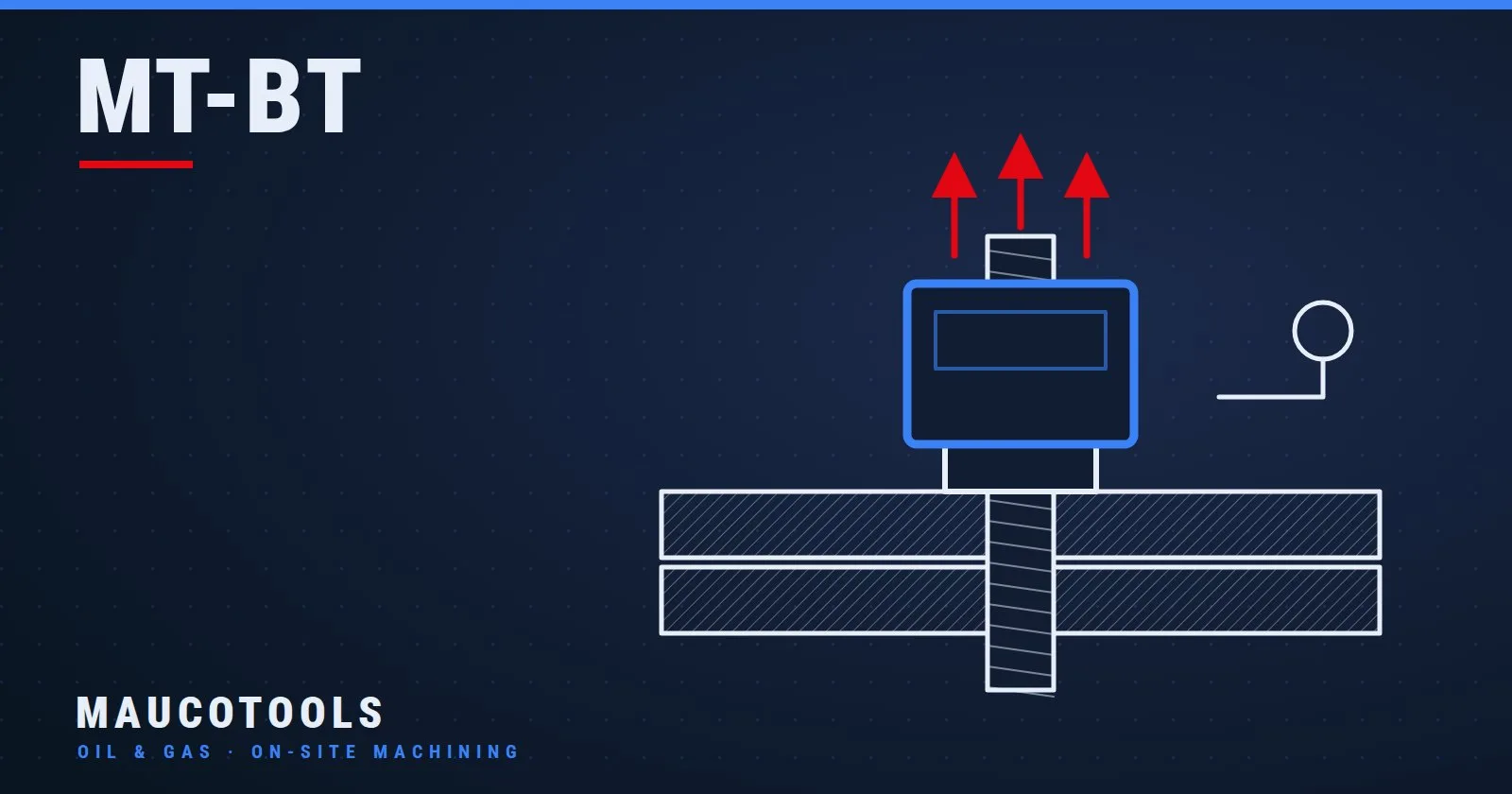
A hydraulic bolt tensioner is an annular cylinder (load cell) that slides over the protruding end of the stud, bears against the flange through a bridge and, once pressurised, pulls the bolt. The nut, free of load during the pull, is turned by hand until it contacts the flange. When the pressure is released the load is transferred to the nut and remains in the stud as preload.
The kit is made up of four elements. The nut rotating socket surrounds the nut and lets you turn it through the windows in the bridge. The bridge transfers the reaction load to the flange. The load cell is the hydraulic cylinder with the annular piston. The puller screws onto the portion of bolt protruding beyond the nut, with a thread engagement of at least one diameter: it is the puller that transfers the tensile load to the bolt.
The physics is that of a spring: pressure times piston area gives the force that stretches the bolt within its elastic range; once the nut is run down and the pressure released, the spring stays stretched because the nut prevents it from shortening. No torsion on the shank, no friction under the nut.
The MT-BT, MT-BTS and MT-SST series add three safeguards: a stroke indicator with a red maximum-stroke line, an internal safety relief that opens in the event of over-stroke, and a floating piston that tolerates up to 2° of misalignment between tensioner and flange. Gasket and sequence are covered in the complete guide to hydraulic bolting.
Tensioner or hydraulic torque wrench: when to choose one or the other
The difference lies in what is being controlled. A hydraulic torque wrench controls torque; the resulting preload depends on friction under the nut and in the thread. The relationship is described in the bolt tightening torque calculation through T = K·D·F, where K sums up everything you cannot see.
The torque calculator helps you size the tool, but the value is indicative for selecting the wrench, not a tightening specification. The tightening torque is a design parameter of the joint, defined by the flange designer, the gasket manufacturer, the OEM or the applicable procedure (ASME PCC-1, VDI 2230). With torque control alone, preload scatter is in the order of ±25–30%.
The tensioner removes the friction variable because nothing rotates under load. Preload is repeatable from stud to stud, and with multi-tensioning the studs are tightened simultaneously: by connecting the load cells to a manifold you cover 100% of the studs in a single pass, or 50% (every other stud) in two passes. The gasket is compressed evenly, without the tilt typical of sequential tightening.
The tensioner is the better choice when the specification calls for an accurate, documented preload, the studs are of large diameter, the flange has many bolts and the shutdown is measured in hours, the gasket is sensitive to uneven loading, or the connection is subsea.
The wrench remains the right choice when the space around the nut cannot accommodate the load cell, the stud is flush with the nut, the joint is not classified as critical, or the jobs are too few to justify a tensioning kit. Maucotools MT-HTW wrenches cover 98 to 136,312 Nm with ±3% repeatability and remain the tool for routine maintenance.
The prerequisite is physical: the stud must protrude beyond the nut by at least one diameter. With studs flush with the nut, you go back to the wrench.
The three series: MT-BT topside, MT-BTS spring-return, MT-SST subsea
Maucotools hydraulic bolt tensioners cover studs from M20 to M150, with a maximum load of 4,754 kN at 1,500 bar on the largest size. All of them feature twin manifold connections; the choice depends on environment, number of cycles and diameter.
MT-BT: the standard topside series
The MT-BT series consists of 12 load cells with a 15 mm stroke, for studs from M20 to M150, body in AISI 4340 steel. The same load cell adapts to the diameters within its range by changing the adapter kit: puller, bridge and nut rotating socket. The BT-1200 reaches M125–M150 and 4,754 kN. It is the series for process flanges, vessels, heat exchangers and heavy structural steelwork.
MT-BTS: spring return for fast cycles
The MT-BTS series has 10 load cells, 15 mm stroke, M24–M110 range, same steel and same 1,500 bar pressure. The difference is in the piston, which retracts automatically when pressure is released: on flanges with many studs and multiple passes there is no need to reset it by hand between one cycle and the next. Maximum load ranges from 330 kN (BTS-200) to 3,768 kN (BTS-1100).
MT-SST: stainless steel subsea
The MT-SST series is built entirely from high-strength stainless steel for subsea use by diver or ROV. The stroke is 25 mm, with fluorescent rings that make the piston position readable in poor visibility; quick-release hooks and a strap hold the tensioner on the stud during positioning; a split nut is optional. The 8 load cells cover M20–M85, including 10K flanges, with maximum load from 188 kN (SST-100) to 2,390 kN (SST-800).
1,500 bar pump units and hoses
Pressure is supplied by three pump units. The two-stage electric MT-TPE-1500 (230 V, 0.7 kW, remote control with 5 m cable, 42 kg) for onshore shutdowns; the pneumatic MT-TPA-1500, 1:350 ratio and 22 kg stainless steel frame, where compressed air is the only energy source allowed; and the manual MT-TPH-1500, 3-litre reservoir and 12 kg, for single tensioning jobs. The high-pressure hoses are 4-layer: 1,800 bar working pressure, 4,500 bar burst pressure, from -30 to +80 °C.
For a planned shutdown or a one-off job it does not always make sense to buy the complete kit: renting the hydraulic tensioners for the shutdown, with load cells, adapters and pump unit already matched to the studs, is the most direct route for occasional use.
How to calculate the load to apply
The tensioner is set by pressure, and the pressure is derived from the load you want to leave in the stud. The starting point is the residual preload: the force that must remain in the bolt once the operation is complete. It is not decided by whoever does the tightening; it is defined by the flange designer, the OEM or the applicable procedure, typically ASME PCC-1 for gasketed flanged joints.
The applied load is always higher than the residual load. When the pressure is released the nut settles onto the flange and the threads bed in under load: part of the elongation is lost, and with it part of the preload. This loss at nut run-down is compensated by the load loss factor.
The rule: applied load = required residual preload × load loss factor, with a factor never below 1.1. The upper limit is just as firm: the applied load must never exceed 95% of the stud's yield strength, because the elongation must remain elastic.
Coverage changes the calculation. With 100% of the studs tensioned together, a single pass is made at the calculated load: no bolt unloads onto the others. With 50% coverage the first pass applies an increased load, because when the second-pass studs are tensioned the flange compresses further and the first studs lose preload; the second pass goes to the nominal value. Pass factors are set by the joint procedure, not by a generic table. Pressure is derived from the load using the piston area of the selected load cell.
Tensioning operating procedure
- Stud check. Check that every bolt protrudes beyond the nut by at least one diameter and that the threads on the protrusion are undamaged and clean. Confirm diameter and grade against the job sheet.
- Fitting the kit. Position nut rotating socket, bridge and load cell; screw the puller onto the protruding thread until it contacts the piston. Repeat on the studs required by the chosen coverage.
- Manifold connection. Connect the load cells through the twin connections up to the pump unit, using 1,500 bar hoses and fittings. Check that all stroke indicators read zero.
- Pressurisation. Raise the pressure to the calculated value, checking that no indicator reaches the red line. If one tensioner reaches its limit before the others, stop: the problem is in the set-up, not in the pressure.
- Nut run-down. With pressure held, turn each nut through the bridge windows until it contacts the flange, at zero torque.
- Release. Release the pressure: the load is transferred to the nut and remains in the stud. With the MT-BTS series the piston retracts on its own; with the other series it must be reset before the next cycle.
- Second pass (50% coverage). Move the tensioners to the remaining studs and repeat pressurisation, nut run-down and release at the nominal value.
- Final check. Verify that no nut has been left loose and record pressures and passes on the job sheet.
On flanges with many studs and multiple passes, the MT-BTS series cuts time because it eliminates the manual piston reset at every cycle.
Common bolt tensioning mistakes
- Insufficient puller engagement. A puller screwed on by less than one diameter loads only a few threads, which deform or strip under tension.
- Studs of unexpected length. Bolts replaced with shorter ones, or nuts taller than the original, change the protrusion: it must be checked bolt by bolt, not by sampling.
- Pressure from a generic table. Applying the pressure of another flange or another diameter is the quickest way to exceed 95% of yield or leave the gasket unloaded.
- Over-stroke. Continuing to raise the pressure after the red line means relying on the internal safety relief, which is a safeguard, not a way of working.
- Mixing tensioning and torque on the same flange. Tightening half the studs by torque and half by tension, without a procedure that provides for it, produces uneven preloads: the two methods do not deliver the same load at the same nominal value.
- Hoses and fittings not rated for 1,500 bar. Using hoses from a lower-pressure system shifts the risk from the tool to the operator.
Frequently asked questions
What is the difference between preload and torque in bolt tensioning?
Preload is the tensile force that remains in the bolt once the operation is complete, and it is what keeps the flange closed. Torque is the moment applied to the nut with the wrench, from which preload results through friction. In tensioning, torque plays no part in the process: the nut is run down at zero torque and preload is controlled by hydraulic pressure.
Is a minimum stud protrusion required to use a tensioner?
Yes: the stud must protrude beyond the nut by at least one diameter, because the tensioner's puller has to screw onto that protrusion with enough thread engagement to transfer the full load. If the protrusion is shorter or the bolt is flush with the nut, tensioning is not applicable and the joint is tightened with a hydraulic torque wrench.
Can a flange be tensioned with only a few tensioners?
Yes, with 50% coverage: every other stud is tensioned in a first pass at an increased load, then the tensioners are moved to the remaining studs for the second pass at the nominal value. 100% coverage closes the flange in a single pass and gives the most uniform preload; the number of tensioners is chosen according to joint criticality and the time available.
What changes in subsea tensioning?
The environment calls for high-strength stainless steel, a longer stroke (25 mm in the MT-SST series versus 15 mm in the topside series) and provisions for reduced visibility: fluorescent rings, quick-release hooks and a strap for positioning by diver or ROV. The physics of preload and the load calculation remain the same.
Does the tensioner replace the hydraulic torque wrench?
No, the two tools coexist. The tensioner is the choice for critical joints with a specified preload, large studs and many bolts to be closed together; the hydraulic torque wrench remains the tool for routine maintenance, confined spaces and studs without protrusion.
The hydraulic bolt tensioner takes friction out of the equation and puts preload under direct control. The Maucotools MT-BT, MT-BTS and MT-SST series cover studs from M20 to M150, topside and subsea, with 1,500 bar pump units.
For a tailored sizing, with load cells, adapter kits and pump unit matched to the studs and the chosen coverage, the hydraulic bolt tensioners page is the starting point for requesting a quotation.
Tensioning works at 1,500 bar: follow site safety rules, wear the required PPE, use only hoses and fittings rated for the pressure and follow the equipment manufacturer's instructions.