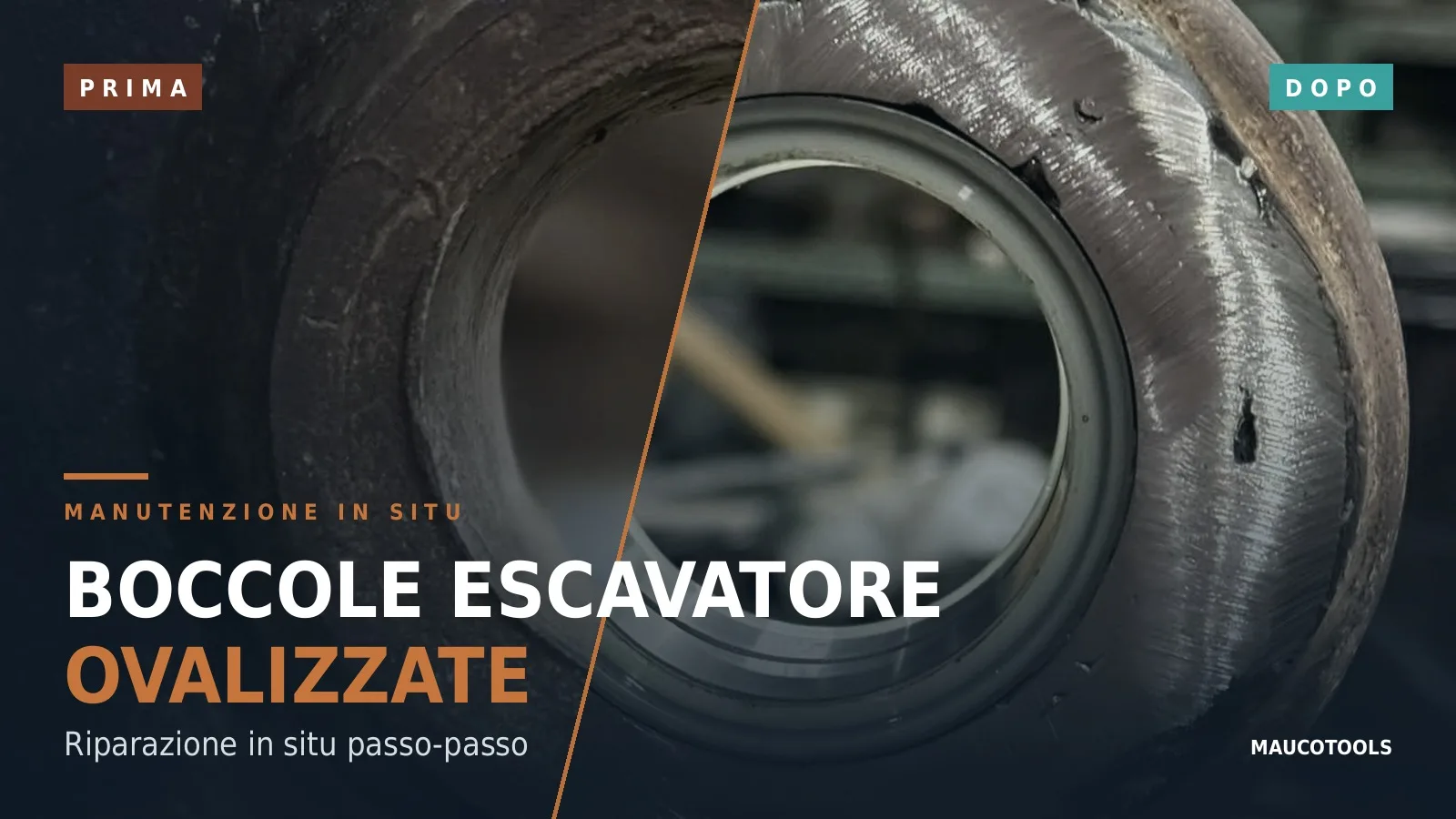
An ovalized excavator bushing is repaired on site with a portable line boring machine: the worn bushing is pulled out, the bore is measured, the missing material is rebuilt with a welding overlay, and the bore is machined back to nominal size, with tolerances down to H7, without dismantling the boom or hauling it to a workshop.
The critical point is understanding where the wear actually sits. As long as the play stays confined between pin and bushing, replacing the spare part is enough. But once the bushing starts to rotate or hammer inside its own seat, the ovalization moves to the bore of the boom or bucket: from that point on, fitting a new bushing into an ovalized seat means finding the same play again after a few hundred hours.
This guide explains how to diagnose the play, how to decide between a simple bushing replacement and a full bore restoration, and how to carry out the complete repair directly on the excavator, with the welding overlay + line boring sequence typical of Dual System machines. For the fundamentals of the process, the complete guide to line boring is the starting point.
Ovalized bushing: what it is and why the seat gets damaged
Ovalization is the uneven wear of a cylindrical bore: the diameter measured along the load direction is larger than the one measured perpendicular to it, and the bore takes on an elliptical geometry. On an excavator the phenomenon typically hits the most heavily loaded pivots: bucket linkage, connecting rod and dipper, boom foot.
The cause is almost always a predictable chain: insufficient or contaminated lubrication → increased friction between pin and bushing → growing play → loads that shift from distributed to impulsive (hammering). At that stage the bushing, which should stay press-fitted with interference, can start to move in its seat and wear the base material of the boom, which is usually not hardened and far less wear-resistant than the bushing itself.
The result is felt before it is even measured: sharp knocks at the start and end of travel, poor bucket precision in finishing work, "spongy" movement under load. Ignoring it does not pay off: the more the seat ovalizes, the more material has to be rebuilt, and the longer the machine downtime will be once the repair becomes unavoidable.
Diagnosing the play: bushing, pin or seat?
Before ordering spare parts you need a correct diagnosis, because the three types of wear call for different remedies. The check is done with the machine shut down and secured, with the pivot unloaded:
Measuring the overall play. With a dial indicator resting on the boom and a lever on the pivot, the total radial movement is recorded. Play visible to the naked eye is already beyond the threshold on most pivots.
Pin inspection. Once the pin is removed, it is measured with a micrometer at several points and on two axes: if it is scored or undersize it must be restored or replaced. This topic is covered in depth in the article on on-site excavator pin tolerance restoration.
Bushing measurement. With an internal gauge or a bore gauge, the bushing bore is measured on two orthogonal axes, at several depths: the difference between the two readings is the ovalization.
Seat measurement, after removing the bushing. This is the step many people skip. The two-axis measurement is repeated directly on the boom bore: if the seat is ovalized, out of size, or shows signs of bushing rotation (polished surface, upset material), replacing the spare part alone will not solve the problem.
Practical rule: the diagnosis is not finished until the bare seat has been measured. A new bushing can mask a compromised seat for a few weeks, but the hammering starts again immediately.
Replace the bushing or restore the seat: selection criteria
The decision point is simple to state: you assess the seat, not the bushing. The bushing is a sacrificial component and is replaced in any case; the real question is whether the bore that houses it is still within tolerance.
Seat in size, cylindrical, with correct interference → replacing the bushing is enough. A quick job, no machining.
Seat slightly out of size but still cylindrical → a clean-up line boring pass with an oversize bushing may be sufficient, where the manufacturer allows it. For this type of work there are also entry-level line boring machines such as the START160 (Ø22–160 mm / 0.87–6.3 in, line boring only, no integrated overlay).
Ovalized seat, undersize not available, or material removed by bushing rotation → rebuilding is required: welding overlay over the entire bore surface followed by boring back to nominal size. This is the typical scenario of neglected pivots, and this is where on-site machining makes the economic difference.
The traditional method for the third scenario — removing the boom, hauling it to a workshop, machining it on a fixed line boring machine and refitting it — multiplies the downtime days. With a portable Dual System line boring machine the same unit performs both the welding overlay and the line boring without ever being removed from the pivot: the component is not dismantled and the alignment between the two phases is not lost.
On-site step-by-step repair: overlay and line boring of the seat
The sequence below is the standard one for an ovalized bushing seat on a boom or bucket, carried out with a portable line boring machine with integrated overlay such as the LBM250 DUAL SYSTEM, which covers a working range of Ø22–250 mm / 0.87–9.8 in (line boring 42–250 mm, internal overlay 32–250 mm) and is the reference for light and medium earthmoving.
Securing the pivot. Attachment resting on the ground or supported, pivot unloaded, pin removed, hydraulic energy isolated according to the manufacturer's procedures.
Extracting the worn bushing with a portable hydraulic press or puller; alternatively, the bushing is weakened with an internal weld bead and slid out.
Cleaning and inspecting the seat: removal of grease and oxide, visual check for cracks, two-axis measurement to quantify ovalization and the excess material to be rebuilt.
Mounting the line boring machine. The bar is centered on the original pivot axis (centering jig or screw supports), verifying the alignment on both ears when the bore is through. On the LBM250 the rotation and feed modules weigh about 17 kg (37 lb) each: assembly can be handled by a single operator even at height, on high booms or on site.
Preparation boring pass. Before the overlay, a clean-up pass returns the bore to a cylindrical geometry, removes the work-hardened material from hammering and exposes sound metal: welding onto an ovalized and contaminated surface is the best way to get a defective overlay.
Internal welding overlay. With the welding head mounted on the same bar, the bead is deposited in a spiral over the whole bore surface, with uniform deposition and without the inconsistencies of manual welding. The switch from the boring configuration to the welding one is quick: in the case documented by Maucotools the setup takes about 14 minutes.
Line boring to nominal size. Once the overlay has cooled, the tool is refitted and the bore is machined to the size prescribed for the interference of the new bushing, with tolerances down to H7. Since the machine has never been dismantled, coaxiality with the original axis is preserved.
Dimensional check: two-axis measurement at several depths, check of surface roughness and of the interference size against the bushing to be fitted.
Pressing in the new bushing (by press or thermal shrink), fitting the pin — new or restored — and full greasing of the pivot.
Functional test: slow no-load cycles, verification of the absence of play with the dial indicator, check after the first working hours.
It is the same sequence applied in the field on the bucket of a Caterpillar 307.5, where Officina Mobile Torsani carried out overlay and line boring on pins and bushings with an LBM250, bringing the tolerances back to H7: the details of the job are in the Heartmoving case study.
Common mistakes in repairing ovalized bushings
Replacing the bushing without measuring the seat. This is mistake number one: the play returns quickly and the second repair costs more than the first, because in the meantime the seat has ovalized further.
Hand-welding the bore and "fixing" it with an angle grinder. A manual overlay is neither concentric nor uniform, and without boring the bushing works on an irregular surface: the interference is not controlled and the bushing starts to rotate again.
Losing the original pivot axis. If centering is done on the ovalized bore instead of the nominal axis (or on the opposite ear that is still in size), the bore is machined out of alignment and the pin works crooked.
Welding without a preparation pass. Depositing the overlay onto work-hardened, oxidized or grease-soaked metal produces porosity and inclusions that surface precisely during boring.
Neglecting the pin. Restoring the seat and refitting an undersize pin recreates the play on the opposite side of the coupling: pin and bushing must always be checked together.
FAQ
When should an excavator bushing be replaced?
When the radial play of the pivot is noticeable or beyond the thresholds indicated by the manufacturer, when the bushing bore is ovalized on the two-axis measurement, or when the inner surface shows scoring and seizing. The bushing is a sacrificial component: it is replaced, not repaired.
Can an ovalized seat be repaired without removing the boom?
Yes. A portable line boring machine mounts directly on the pivot and works on site: with a Dual System machine such as the LBM250 you perform an internal welding overlay and boring to nominal size without removing the boom or hauling it to a workshop, keeping coaxiality with the original axis.
What tolerance is needed between bushing and seat?
The bushing must be fitted with the interference prescribed by the excavator manufacturer, which depends on diameter and material. The line boring operation must guarantee a precise and repeatable size: with Maucotools portable line boring machines tolerances down to H7 are achieved, suitable for the interference press fits typical of earthmoving pivots.
How long is the downtime for an on-site repair?
It depends on the diameter, the number of seats and the material to be rebuilt, but the on-site job eliminates the longest items of the traditional method: removing the boom, hauling it to a workshop and waiting for machining. In many cases the pivot is rebuilt and refitted within the same working day.
An ovalized bushing seat is not solved with a spare part: it is solved by rebuilding the geometry of the bore. The diagnosis → extraction → overlay → line boring → press-fitting sequence, carried out on site with a single machine, brings the pivot back to its original tolerances while cutting excavator downtime from weeks to days, often to hours.
To estimate what this difference is worth for your own fleet — downtime hours, transport, external machining — the Maucotools ROI calculator is available, while the LBM250 DUAL SYSTEM datasheet lists the working ranges and available drives, electric at 1.8 kW or hydraulic at 5.5 kW.
Welding operations and work on pivots must be carried out by qualified personnel, in compliance with the applicable safety rules and the manufacturer's instructions.